Showing posts with label cheetah. Show all posts

28 May, 2019

TANO BORA CHEETAHS


This coalition of five cheetahs in the Masai Mara moved to Olare Orok Conservancy recently taking a break from their territory in Masai Mara reserve. This famous coalition of five – the biggest ever recorded of unrelated males - could have sought new hunting grounds because it might be easier to hunt away from the Masai who take their cows to graze in the reserve at night forcing the cats to move away from their territories.

Anyway soon after crossing into Olare Orok Conservancy, the famous five hunted their first prey - a young warthog.


The Cheetahs feasted on the warthog which was just a snack for them.


As they were eating we noticed that one of the cheetahs had a severe injury on the testicle.


We immediately called cheetah researcher, Dr. Elena V.Chelysheva who is the founder of the Mara Meru Cheetah Project. She was not aware of the injury and alerted Dr. Limo who is the Kenya Wildlife Service vet. The researcher arrived soon followed by Dr. Limo who treated the cheetah.


A few days later the cheetahs crossed the Talek River and into the reserve spending most of the time in the open plains where it is easier to hunt.


The treated cheetah back on his paws.

Written by Pauline Omaribe
Photos by Mara Intrepids driver guide Silas Siele and Mara Meru Cheetah Project.

27 March, 2018

Hunting Independently


Weather

March began with heavy rains which washed away some camps, flooded the rivers and made the bridges impassable.


However the rains brought a sigh of relieve for the wildlife and the communities that were desperately looking to the rainy season. The livestock belonging to the Masai communities had been ravaged by the drought.


It’s cool most of the time with temperatures ranging between 16ºc in the mornings and evenings to 24ºc during the day.

Wildebeest Phenomena in the Mara

The wildebeest began to drop their young in the Mara in February and are still giving birth in large numbers. This is a phenomenon because wildebeest give birth in the Serengeti and in the Loita Plains but not in the Mara.


The Loita herds of wildebeest and zebra are back in the park heading south towards the Talek River. Some have crossed to Possee Plains.


General game
Game viewing has been good with lots of plains wildlife feasting on the green pastures and water.


The topi continue to rut. Males display their dominance in the breeding grounds (leks) with females moving in and out of them.

Warthogs, buffalos, Maasai giraffes are well fed and calving. Herds of eland are common around the Mara Intrepids camps where they are marooned between the Olare Orok and Ntiakitiak Rivers.


On a recent early morning game drive we saw a python strangle and swallow a dikdik.  


Predators

Lions
The Olkiombo Pride

It is reclaiming its former territory along the Talek River. The pride has two big, dominant males named Maridadi and Kaka including four females and nine cubs.
Maridadi seems to be a bit bigger than his coalition mate and has been crossing the Talek River but does not venture far from it. He may be looking for new territory.


The Ridge Pride
It’s in its territory at the Topi Plains. The pride was seen feasting on a cow and a hippo. Blacky and Lipstick are still the dominant males. There are also three young males in the pride who may be kicked out soon as they are almost sexually mature.


The Enkuyanai Pride
It’s along Ntiakitiak River, crossing the river every time the water goes down. The lions killed a buffalo and they feasted on it for three days. The dominant males - Oloolpapit and Olbarnoti – then started to mate.


Leopards
Bahati
She and her cubs are roaming around the Mara Intrepids.  We have named the two cubs Hatari (the male cub) and Bella 2 (the female). They seem to be separating from their mother at a very early age as they are barely one year old. However the cubs are already independent and hunt for themselves. On several occasions, they have been seen with kills of young impala and scrub hares up in the trees.


Recently, Bahati killed a big male impala but didn’t bother to call the cubs. She ate for two days and left without looking for the cubs.


Kaboso
She and her two cubs are also doing well. Kaboso with the help of her older male cub Blue Eyes is keeping a serious watch over the cubs as there are many baboons and hyenas around. Blue Eyes helps his mother to hunt gazelles and warthogs.

Luluka
She’s at Olkeju Rongai and has been seen with gazelle and impala kills up on a tree on different occasions.


Cheetahs

Malaika
She and her two male cubs were on the western side of Olare Orok River when the water level was at its highest.  There are unconfirmed reports that Malaika may have tried to cross the flooded river and drowned.


Other reports are that she may have left her cubs who are now old enough to hunt.
Malaika had shown some signs of coming on heat and we our keeping our fingers crossed that she is fine. Her cubs are still searching for her.

Imani
She had a new litter of four cubs around the Lookout Hill.  She has lost one and we hope the remaining three will survive as she seems to be taking very good care of them.


By R. Koikai

Senior driver-guide at Mara Intrepids/Explorer Camps

23 August, 2017

The Migration Series

Weather

Dry but with very cold early mornings - temperatures as low as 15 degrees Celsius. The day warms up to 30 degrees Celsius.
Evenings get cool with temperatures at 18 degrees Celsius.


Rivers
There have been no rains in the Mara for some weeks except in the northern and eastern parts which has made it possible for the rivers like the Talek and the Olare Orok to swell and flow.
The Mara River – the life-lung of the Mara – is quite high meaning that there is some rain in the Mau forest - the source of the river.


Wildlife

With the onset of the migration, there is spectacular wildlife with the big herds of wildebeest and zebra spread all over the savanna grasslands.


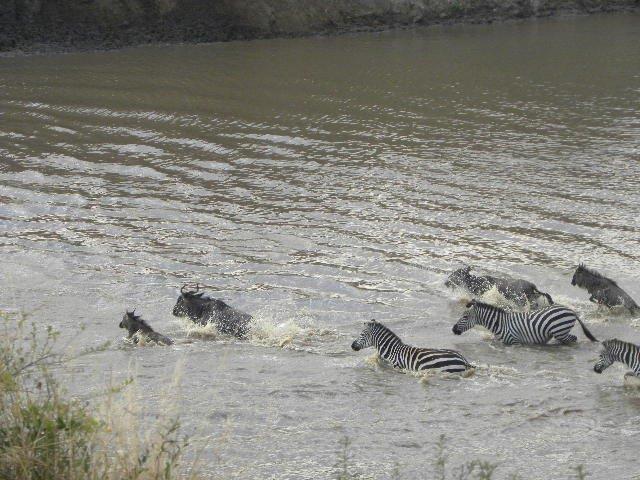
There have been fantastic crossings over the Mara River with lots of wildebeest and zebras crossing at different points. All seem to be heading towards the Mara Triangle and to the salt lick at Enkoiguaate at the base of the Oloololo Escarpment. This area is very lush because it was burnt recently before the rain for fresh grass to regrow.
Some of the crossings have been at Lookout Crossing and Paradise Crossing.
At Rhino Ridge and Topi Plains near Mara Intrepids and Mara Explorer camps there are several hundreds of wildebeest and zebra making their way to the Mara River.


An interesting observation:  An albino zebra on the southern side of the Mara Intrepids and Explorer camps.


During the annual migration of the wildebeest from the Serengeti, elephants tend to move to less crowded areas but there have been sightings of families of up to 15 individuals by the riverine forests in search of pasture as there is hardly anything for them to eat on the plains.
Rhinos have been seen at Olkeju Rongai and around Chemarta.
Buffalos are common but out-numbered by the migrating wildebeest and zebras. Several hundreds’ are calving.  
Eland are also common by the sundowner site by the camp.
Giraffe, impala and gazelles are in plenty despite the dry season.


Predators

Lions

Ridge Pride: doing very well with the pride growing in size with a new set of cubs. Most of the adult females are also pregnant.
The pride has been at Double Crossing and having a great time hunting wildebeest every two days. The three sub-adult males (Mandevu) and their sister Ashlina seem to be getting pushed out of the pride. They have been seen on their own trying to hunt near Rhino Ridge. The dominant males - Blacky and Lipstick- are still in charge of the pride, going strong.


Paradise Pride and the Rekero breakaways: Doing great. They have several cubs.

The Musketeers are in charge of both prides. The prides are around Paradise Crossing and Chemarta hunting wildebeest and zebras.

Long Face who was the dominant male for the Maji ya Eland pride has been loitering around Rekero Crossing and Smelly Crossing. He seems unsettled since he was pushed out of his pride by the four nomads. He was last seen alone at Smelly Crossing.


Lookout Pride: Is below Lookout Hill doing well with the Notch boys in charge though they seem to be getting frail due to old age.

Cheetahs
The coalition of five male cheetahs who are of different ages have been giving us some very good sightings in most parts of the park.
They are also hunting wildebeest and at times they have made multiple kills. They seem to move a lot at night. They moved into the Olare Orok Conservancy for a night and the next day they were seen at Olkeju Rongai which is quite a distance for them to cover in a night.


Imani has left her cubs. The cubs are moving around Rhino Ridge, Possee Plains and Maji ya Eland. They have been successfully hunting - though the kills are small and sometimes they lose them to hyenas.

Malaika - the grand dame of Mara - and her two cubs are also in the same area but a bit further at Concrete Crossing near Lookout Hill. The cubs seem to be doing well but Malaika is getting weak and less efficient at hunting.


Leopards

Bahati: She and her two cubs have been elusive and spotted only once at Mara Intrepids’ Swing Bridge across the Talek River.

Her elder son Safarilink was seen in the same area. They are doing fine and the little cubs are growing.
Kaboso and her two cubs and the older cub are doing very well. They have been seen together sharing kills.
This family has been roaming between Olare Orok River and Kaboso crossing point. They have been hunting wildebeest calves as they cross the rivers.


News alert!

African Wild Dog

We had another rare sighting of a lone hunting dog at Double Crossing who was a bit nervous, running up and down.
The African hunting dog has a satellite collar fitted by researchers to learn more about his movements.
In the early 20th century, the African hunting dog was almost shot to extinction as farmers saw it as vermin.
Numbers are now on the increase.


Senior driver-guide at Mara Intrepids Camp
By Raphael Koikai 

31 January, 2017

First Animal Sightings in Mara 2017

Weather
Very hot during the day with clear skies.
Chilly in the early mornings and at night.
Sunrise: 6:50am
Sunset: 6:55pm
As usual both are spectacular and best time for photography.

Temperatures
180c morning
300c at midday
270c after sunset

Wildlife
Early morning and late evening game drives have been spectacular with lots of plains game concentrated by the rivers, especially the Talek and Olare Orok. These rivers still have some pools of water though they are stagnant.
We have some incredibly large herds of buffalo including Maasai giraffes with calves near Mara Intrepids close to Olare Orok River where there is some grass.


Elephants are scarce during this dry season. They have taken to breaking trees in the forest to forage on the leaves and branches. A few herds can be seen along the rivers where the trees are lush and green.


The wildebeest and zebra from Loita hills are in plenty especially around the Topi plains and it looks like a mini migration happening. It seems like the wildebeest and zebra are not migrating back to the Loita plains because of people settling on their migration routes, and erecting wire fences. This for the predators is a blessing because it means more food for them.


The wildebeest are calving and we expect it to peak in February. It’s unusual for the wildebeest to give birth in the Mara. Historically they give birth in the Loita plains and in the Serengeti.
Other herbivores are in plenty - topis, Thomson gazelles, impalas, Grants gazelles, elands and others – but it’s a lean time for them because of the dry season.

PREDATORS
Lions
Enkuyanai Pride
A pride of 18 lions with Romeo2 as the dominant male. However since his brother Mohican was killed in a territorial fight late last year, Romeo2 has been going through tough times bullied by two dominant males - Olbarnoti and Oloolpapit - from the Olare Orok Conservancy.  They killed Mohican and are still trying to take over the pride.
On New Year’s eve, we watched Romeo2 and his pride being chased for two hours by these two.


Romeo2 is still in charge of the pride but it seems like his fate hangs in balance as long as Olbarnoti and Oloolpapit are around.

Olkeju Rongai Pride
This pride has also had a bad start to the year as there are four nomadic males from Sand River. The four had a serious fight with Long Face the dominant male and Napejo the eldest female in the pride.  A young female was killed and serious wounds inflicted on Napejo and Long Face. The pair was treated by vets.


The nomads meantime are around Talek River at the Possee Plains. They chased the females and their cubs to Olmisigiyioi south towards the Serengeti border. Long Face is very frail and was last seen along the Talek River.

The Ridge Pride
Doing very well with eight cubs.  Now that the Loita plains herds are at Topi plains - which is the pride’s territory - they have been hunting every day with multiple kills on some days.


Blacky and Lipstick the dominant males in the pride are in great shape and have of late been mating. The three young males from the previous litter have been pushed out of the pride. They are now not allowed to share food with the rest of the pride. These are signs that the three are no longer tolerated in the pride.

The Paradise Pride
This pride has six cubs and was seen feasting on a dead hippo. The four musketeers from the pride disappeared for a while and reports were that they had crossed over to the Mara Triangle. They are now back home and were seen sharing a dead hippo with the pride at Chemarta.


Leopards
Kaboso the female gave birth to two cubs at the beginning of the year. They are active and seen almost every day. Kaboso has a new kill every other day and the cubs have really grown. The two cubs from the previous litter are also doing well but have split from the female cub around the first crossing at Double Cross. The male cub is around Chumvi Chumvi.


Bahati has been seen near Mara Intrepids and Explorer. She seems to be suckling but has not brought out the cubs.


The male cub from the previous litter is around Rekero.
Lorien is at Olkeju Ronkai actively hunting.

Cheetahs
Malaika is the only cheetah around the Camp and seen every day with her two cubs. She has of late been at Rhino Ridge making kills almost every day because the cubs are growing and need to be fed.
Malkia, Malaika’s cub from the previous litter is also around the Rhino Ridge and Topi Plains trying to hunt but not with much success.


There is a lone male around wearing a radio collar. We think he is from the Olkinyei Conservancy. 

Article and Pictures By Raphael Koikai, Senior driver guide