Showing posts with label birding. Show all posts

29 May, 2019

CAPTIVATING NATURE


Grosbeak weaver/Thick-billed weaver (Amblyospiza albifrons)


The thick-billed weaver constructs a distinctive nest which is compact, woven with thin strips of reeds and hung between the upright stems of reeds.
-  It is globe-shaped with the entrance (unlike other weaver nests) near the top and facing to the side.
- The male weaves the nest with fine material leaving a neat impression, but the weave is in fact not as complex or developed as that of other weaver species.
The initial entrance is large, but when a female has chosen the nest the entrance reduced to a narrow opening.
- Thick-billed weaver colonies may involve a single male, or may contain several males, and is usually established in a reed.
- Thick-billed weavers are polygamous, in that a single male attempts to attract and mate with several females.


 A male may attract up to six females, and up to three nests may be active in any male's territory at once.
-  When found at low density there are many apparently monogamous pairs, but they normally nest in small colonies.
-  After mating the female normally will lay a clutch of 3 whitish pink eggs, spotted with red, purple and brown.
-  The incubation of the eggs is carried out solely by the female.
This lasts 14 to 16 days and the chicks are fed by regurgitation by the female until they fledge, though occasionally the male may also feed the young.
The chicks fledge after about 18 to 20 days in the nest.
- The nests are vulnerable to predation and recorded nest predators include the white-browed coucal, house crow and the Nile monitor.
- After the nests have been used by the weavers they may be commandeered by climbing mice, or used for breeding by the orange-breasted waxbill or brown fire finch.

    Did you know that:
-  Male impalas produce a scent from a gland on their foreheads to advertise their status to rivals.

TREES/SCRUB


         Common Name:  Castor Oil Plant

          Swahili Name: Mbarika


 Usage and treatment

·         Part used- Roots bark,leaves, & fruits

v  Castor is a plant that produces seeds (beans). Castor oil is produced by pressing ripe seeds that have had their outer covering (hull) removed.
v  The hull contains a deadly poison called ricin. Castor oil has been used as medicine for centuries.
v  Castor seeds without the hull are used for birth control, constipation, leprosy, and syphilis.
v  Castor oil is used as a laxative for constipation, to start labor in pregnancy, and to start the flow of breast milk.
v  Some people apply castor seed paste to the skin as a poultice for inflammatory skin disorders, boils, carbuncles, pockets of infection (abscesses), inflammation of the middle ear, and migraine headaches.
v  Castor oil is used topically to soften skin, bunions and corns; and to dissolve cysts, growths, and warts.
v   It is also applied to the skin for osteoarthritis.
v  Some women put castor oil inside the vagina for birth control or to cause an abortion. Castor oil is used in the eyes to soothe membranes irritated by dust or other materials.
v  In manufacturing, castor seeds are used to make paints, varnishes, and lubricating oils.
v  Ricin from the hull of the castor seed has been tested as a chemical warfare agent. Weapons-grade ricin is purified and produced in particles that are so small they can be breathed in.


The smaller the particle size, the more poisonous the ricin. You may remember that ricin was found in letters sent to some Congress members and the White House, and in the possession of people linked to terrorist and anti government groups.

28 May, 2019

HARTLAUB’S TURACO (Tauraco hartlaubi)


The Hartlaub’s Turacos (Tauraco hartlaubi) have been at the Great Rift Valley Lodge since mid-November 2018, having flown in from the neighbouring Eburru forest during the recent drought. The colourful turacos love to feed on the fruits of the Chinese berry, the Rhus natalensis, pepper tree and fig tree.


The turacos are in the bird family Musophagidae (literally ‘banana-eaters’), which includes plantain-eaters and go-away birds. In southern Africa both turacos and go-away birds are commonly known as loeries.
They are semi-zygodactylous. This means that the fourth (outer) toe can be twitched back and forth. The second and third toes, which always point forward, are conjoined in some species.
The turacos are noted for peculiar and unique pigments giving them their bright green and red feathers.
They are medium-sized arboreal birds endemic to sub-Saharan Africa, where they live in forests, woodland and savanna.


Their flight is weak, but they run quickly through the tree canopy. They feed mostly on fruits but will also eat leaves, buds and flowers, occasionally taking small insects, snails, and slugs.
As their name suggests, turacos enjoy bananas and can become tame as to be hand-fed. They are also partial to grapes and pawpaw (papaya).
They build large stick nests in trees, and lay 2 or 3 eggs. The young are born with thick down and open or nearly-open eyes.

23 August, 2017

The Migration Series

Weather

Dry but with very cold early mornings - temperatures as low as 15 degrees Celsius. The day warms up to 30 degrees Celsius.
Evenings get cool with temperatures at 18 degrees Celsius.


Rivers
There have been no rains in the Mara for some weeks except in the northern and eastern parts which has made it possible for the rivers like the Talek and the Olare Orok to swell and flow.
The Mara River – the life-lung of the Mara – is quite high meaning that there is some rain in the Mau forest - the source of the river.


Wildlife

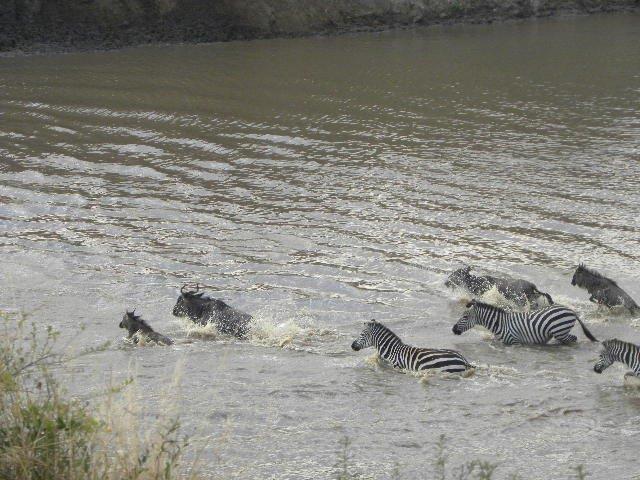
With the onset of the migration, there is spectacular wildlife with the big herds of wildebeest and zebra spread all over the savanna grasslands.


There have been fantastic crossings over the Mara River with lots of wildebeest and zebras crossing at different points. All seem to be heading towards the Mara Triangle and to the salt lick at Enkoiguaate at the base of the Oloololo Escarpment. This area is very lush because it was burnt recently before the rain for fresh grass to regrow.
Some of the crossings have been at Lookout Crossing and Paradise Crossing.
At Rhino Ridge and Topi Plains near Mara Intrepids and Mara Explorer camps there are several hundreds of wildebeest and zebra making their way to the Mara River.


An interesting observation:  An albino zebra on the southern side of the Mara Intrepids and Explorer camps.


During the annual migration of the wildebeest from the Serengeti, elephants tend to move to less crowded areas but there have been sightings of families of up to 15 individuals by the riverine forests in search of pasture as there is hardly anything for them to eat on the plains.
Rhinos have been seen at Olkeju Rongai and around Chemarta.
Buffalos are common but out-numbered by the migrating wildebeest and zebras. Several hundreds’ are calving.  
Eland are also common by the sundowner site by the camp.
Giraffe, impala and gazelles are in plenty despite the dry season.


Predators

Lions

Ridge Pride: doing very well with the pride growing in size with a new set of cubs. Most of the adult females are also pregnant.
The pride has been at Double Crossing and having a great time hunting wildebeest every two days. The three sub-adult males (Mandevu) and their sister Ashlina seem to be getting pushed out of the pride. They have been seen on their own trying to hunt near Rhino Ridge. The dominant males - Blacky and Lipstick- are still in charge of the pride, going strong.


Paradise Pride and the Rekero breakaways: Doing great. They have several cubs.

The Musketeers are in charge of both prides. The prides are around Paradise Crossing and Chemarta hunting wildebeest and zebras.

Long Face who was the dominant male for the Maji ya Eland pride has been loitering around Rekero Crossing and Smelly Crossing. He seems unsettled since he was pushed out of his pride by the four nomads. He was last seen alone at Smelly Crossing.


Lookout Pride: Is below Lookout Hill doing well with the Notch boys in charge though they seem to be getting frail due to old age.

Cheetahs
The coalition of five male cheetahs who are of different ages have been giving us some very good sightings in most parts of the park.
They are also hunting wildebeest and at times they have made multiple kills. They seem to move a lot at night. They moved into the Olare Orok Conservancy for a night and the next day they were seen at Olkeju Rongai which is quite a distance for them to cover in a night.


Imani has left her cubs. The cubs are moving around Rhino Ridge, Possee Plains and Maji ya Eland. They have been successfully hunting - though the kills are small and sometimes they lose them to hyenas.

Malaika - the grand dame of Mara - and her two cubs are also in the same area but a bit further at Concrete Crossing near Lookout Hill. The cubs seem to be doing well but Malaika is getting weak and less efficient at hunting.


Leopards

Bahati: She and her two cubs have been elusive and spotted only once at Mara Intrepids’ Swing Bridge across the Talek River.

Her elder son Safarilink was seen in the same area. They are doing fine and the little cubs are growing.
Kaboso and her two cubs and the older cub are doing very well. They have been seen together sharing kills.
This family has been roaming between Olare Orok River and Kaboso crossing point. They have been hunting wildebeest calves as they cross the rivers.


News alert!

African Wild Dog

We had another rare sighting of a lone hunting dog at Double Crossing who was a bit nervous, running up and down.
The African hunting dog has a satellite collar fitted by researchers to learn more about his movements.
In the early 20th century, the African hunting dog was almost shot to extinction as farmers saw it as vermin.
Numbers are now on the increase.


Senior driver-guide at Mara Intrepids Camp
By Raphael Koikai 

14 March, 2017

GRVL Fun Facts

Trees/shrub

Common Name: Broad-leaved Croton

Swahili Name: Mfurufuru


Usage and treatment

Part used: Leaves, fruits, seeds and stem
 Attractive tree often planted to provide shade in plantations
 Stabilizes and enriches the soil
 Seeds are used as a fish poison
 A vegetable salt is prepared from the ashes of the burnt leaves
 Most parts of the plant are used to treat various conditions
 The juice from the leaves is used as an anthelmintic to rid the body of parasites and toxins
 A root decoction is used as an anthelmintic for tapeworm
 The juice is also for dealing with skin problems, applied on wounds to hasten clotting and treat sores, warts and ringworm
 The leaves or young shoots are eaten to treat fever and oedema
 A boiled leaf decoction is drunk, or the ashes taken orally, as a treatment for cough
 A decoction of the young leafy shoots, combined with Justicia schimperiana, pepper, butter and milk, is used in the treatment of jaundice, and for an eruptive disease resembling small-pox
 An extract of leaves is used against itchy scalp, as a purgative, to treat malaria and venereal diseases
 The bark is an ingredient for effective purgative and vermifuge
 The seed is eaten to procure abortion
 A preparation of the seed is instilled into the ear as a remedy for ear-troubles
 The crushed leaves and seed mixed are drunk in water as a remedy for tapeworm.

Fun fact:
 Eburru forest has diverse habitats
 It’s home to 188 known species of birds
 Here are some of the most beautiful ones

Doherty's bush shrike

Eastern double-collared sunbird   
By Kilonzo, senior naturalist at the Great Rift Valley Lodge

25 April, 2014

Why Mzee Pavo Lost His Feathers

Mzee Pavo (the peacock) lost his feathers a month ago due to moulting.

Birds moult periodically, shedding old feathers for new. Feathers are dead structures which gradually need to be replaced. Adult birds can moult up to three times a year.


Moulting is a slow process because birds rarely shed all their feathers at once. A bird must retain sufficient feathers to regulate its body temperature and repel moisture. The number of feathers that are shed varies. In some moulting periods, a bird may renew only the feathers on the head and body, shedding the wing and tail feathers during a later moulting period.

Some species of birds become flightless during an annual "wing moult" and must seek a protected habitat with a reliable food supply during that time. While the plumage may appear thin or uneven during the moult, the bird's general shape is maintained despite the loss of feathers.


The process of moulting begins with the bird shedding some old feathers. The pin feathers replace the old feathers. As the pin feathers become full feathers, other feathers are shed.

The feather loss is equal on each side of the body.


Feathers make up 4–12% of a bird's body weight and it takes a large amount of energy to replace them. For this reason, moulting often occurs immediately after the breeding season, while food is still abundant. The plumage produced during this time is called postnuptial plumage.

Report by Daniel Kilonzo, Resident Naturalist at Great Rift Valley Lodge and Golf Resort. 

Heritage Hotels (Kenya) manages The Great Rift Valley Lodge and Golf Resort in Naivasha, just an hour an a half's drive from Nairobi. The lodge is famous for one the longest holes in Kenya - the par 5 -  17th ‘signature’ at 598 metres (654 yards)!
 ©Heritage Hotels Ltd, Kenya.