Showing posts with label Samburu Reserve. Show all posts

30 May, 2019

Samburu's Sad Mother Nanai


Recently this mother by the name Nanai has been modeling with her three cabs. She has been longing to bringing up one of the biggest prides in Samburu region. The kids have really been growing very fast the reason for the mum’s pride.  Unfortunately her dreams were not without challenges. She lost one of the cabs last weeks. She has since been very careful with her remaining two cabs. Most of the time she has been sighted recent she has been without cabs and on very strategic places.


We had several good and unique sightings this week.

Beisa Oryx


Grazing on the flat plains of buffalo springs reserve were several browsers and grazers. They prefer flat plains so that they are able to see a predator from a distance. Beisa Oryx is one of the special five animals that we have around. Following the previous season plenty rains, there is enough grass for these cute Oryx only found in Samburu regions. Their unique tall ringed horns and clear black line marking on their body with perfect blend of brown and white colors is the main source of beauty. They are heterogeneous so you will find them in herds

White River Female


This cute female leopard has been making us proud every day of the week. Mainly found in the area of the now all whether white river. She has been pausing for every tourist for unique photos. Surely if it was a fashion contest she would easily walked away as overall winner. She is our Miss tourism Samburu.


She has been very lucky with kills. More than once we have found her enjoying the meat on top of the tree. This has only made her look prettier. One of the evenings she showcased how she does by bring down a full grown up he-impala


 The Lucky Cheetah


Sharing the same territory with oryx, impalas, grant gazelles and other antelopes, these cheetahs had plenty of time hunting the smaller antelopes. Only half of the chases, which last from 20 - 60 seconds, are successful. They are found mostly in these partially open savannas because they rely on tall grasses for camouflage when hunting. They are diurnal (more active in the day) and hunt mostly during the late morning or early evening.
Unlike other big cats, cheetahs cannot roar. However, they can purr on both inhale and exhale, like domestic cats!

Did You Know?
When cheetahs are running, they use their tails to help them steer and turn in the direction they want to go, like the rudder of a boat.

27 March, 2019

A Wildlife-Haven in Samburu

The reserve in Kenya’s northern arid lands is one of Kenya's best-loved wildlife reserves. In complete contrast to the rolling savannah grasslands of the Maasai Mara, Samburu is filled with hills and dry riverbeds (luggas) with the Ewaso Nyiro River meandering along groves of the iconic doom palms. It has a wealth of wildlife with lions, leopards and cheetahs hunting down antelopes, zebra and other herbivores. The elephants are one of the longest studied in Africa.

Samburu Intrepids is the jewel in the reserve. With its experienced guides you will be able to see much of what the reserve has.

Lion of Samburu
These lions will rest after hunting down the rare Grevy’s zebra that is only found north of the equator. It may look easy but hunting is a strenuous exercise.


Did You Know?

Both male and female lions roar?
A lion’s roar can be heard from five miles away. Lions are also the second largest living feline after the tiger.

Leopards


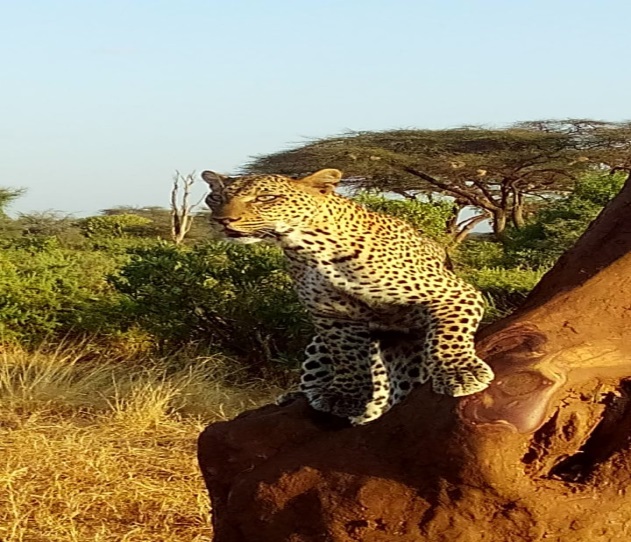
Leopards climb to higher spots to look for prey. They will then prepare for a kill. One would think this one is posing for a photo shoot.

Did You Know?
Leopards are very agile, and can run at over 36 miles per hour, leap over 20 feet and jump up to 10 feet.

Elephants


Elephant calf suckling
Did You Know?
Mating Season: Mostly during the rainy season.
Gestation: 22 months.
Litter size: 1 calf (twins rare).
Calves weigh between 200-250 pounds at birth. At birth, a calf's trunk has little muscle; 
therefore it will suckle through its mouth. It takes several months for a calf to gain full control of its trunk.


Grey-headed Kingfisher (above) and Palm-nut vulture

Birds
Samburu boasts over 350 species of birds.

Samburu People
They are one of the few tribes who have maintained their culture. They are nicknamed the butterfly people because of their bright coloured attire as seen in the picture.


The doum palm is iconic Samburu.


Top: Lioness and elephant

Above: Elephants against a doum palm in Samburu after the rains. That’s why the grass is green.

Written by Maurice Njeru, Manager Samburu Intrepids.


24 August, 2018

Adventure at Samburu!

Elephants

Elephants form deep family bonds and live in tight matriarchal family groups of related females called a herd. The herd is led by the oldest and often largest female in the herd, called a matriarch. Elephants are extremely intelligent animals and have memories that span many years. It is this memory that serves matriarchs well during the dry seasons when they need to guide their herds, sometimes for tens of miles, to watering holes that they remember from the past. They also display signs of grief, joy, anger and play.
The mating season for elephants is mostly during the rainy season and the gestation period is 22 months.


A lone elephant heading to the bush. The elephant was the only one around this area. More elephants where spotted in the distance distance.


River Ewaso Nyiro which means ‘river of brown water’ is the only source of water for wildlife in Samburu National Reserve. This season it has little water in it. The elephants were seen at the river, taking their time to quench their thirst. A lioness walked past them for a drink also.


During the dry season, the flat top acacias bear seed pods which are healthy for livestock and wildlife. Elephants enjoy the acacia seeds after quenching their thirst at River Ewaso Nyiro.
Compiled by Chris Letur, Camp naturalist

02 August, 2018

Nanai the Lion


The Koitogo pride of lions in Samburu National Reserve is named after the famous hill in the heart of the reserve. There are 21 lions in the pride. On a recent evening game drive we saw one of the females from the pride called Nanai (a Samburu word meaning mine) and her cubs aged five months walking on the road.


Nanai came out of the bushes followed by her cubs and walked majestically along the road.


We got some beautiful photos of the cubs. To my surprise the cubs were not shy of the vehicle. Instead they stared at us as if they were also taken by surprise.


We followed Nanai and her cubs for a while until we reached the banks of the Ewaso Nyiro River which is the main source of water in this dry semi-arid land. That's when we realized that Nana’s intention was to take her cubs to drink water. After drinking, they came up the river bank. While the cubs played, Nanai looked around for prey.


She then let the cubs go in to the bushes as she hung around the banks. Nanai is one of the famous female’s seen most of the time around the reserve. She is about nine years old and really struggles to bring up her cubs. We wish her plus her new cubs all the best.

Written by Justus Kisoo | Samburu Intrepids Camp | Heritage Hotels Ltd.  

29 June, 2016

Samburu Safari Diary

ELEPHANT DUSTING
At Samburu National Reserve in northern Kenya, elephants are often seen giving themselves a dust shower. Using their trunks, they inhale the dust and blow it out forcefully. It’s quite an amazing thing to see. The dust serves as a sunscreen, keeps the animal cool and insects at bay.

Wild pigs also roll themselves in dust to protect themselves for the same purpose.

Klipspringers Spotted


Klipspringers spotted recently at Koitogo hill in Samburu National Reserve proved to be exciting for our guests who had never seen this antelope before.  My mission was to spot a leopard but the klipspringers proved to be equally interesting.


Klipspringers are small antelopes that live in rocky places. They are well-adapted to their environment. Their fur has hollow shafts that act as shock absorbers should they slip off the rocks and their hooves are pointed like a ballerina’s to hop on the rocks. They pair for life like the smaller dik dik.


Lions
This week we had a great sighting of Lguret, one of the oldest males in Samburu and Buffalo Springs national reserves with his cubs. Male lions will babysit the cubs while the lionesses are our hunting.


Young males will usually kill any cubs they find in a pride when they become the dominant male.  They want to pass their genes on and mark their territory.

Wild dogs
An endangered species, Africa wild dogs are seen in the reserve during the dry months of July and August when water is available inside. The picture was taken a few meters from the camp.


Ruppell's Griffon Vulture
When soaring, this magnificent bird can spot a carcass nearly 10 kilometers away! Known to be the world’s highest flying bird, in 1973 one collided with an airplane off the Ivory Coast. The plane was flying at a height of 37,000 feet, which is higher than Mount Kilimanjaro at 19,340 feet high!
Image Source Mother Nature Network
37,000feet asl is also the height at which a human would pass out from lack of oxygen. The vulture doesn't face this problem because it has developed a particular type of haemoglobin, making their use of oxygen more effective.

Long Crested Eagle
The long crested eagle is found in sub-Saharan Africa. It’s one of my favorite birds of prey among the 300-plus species found in the reserve.

Dairy of a Naturalist by Jelly Loloju, driver guide at Samburu Intrepids Camp

17 April, 2015

Samburu Intrepids Camp - Easter Sightings

A young male cheetah near Larsens Camp was seen. He looks new in the area.

At Samburu National Reserve, we have a good number of cheetahs. For the last six months, we have had regular sightings of two females, each with two cubs. One female and her cub are at Samburu National Reserve and the other female and her cub are in Buffalo Springs National Reserve. There are other cheetahs but rarely seen because they are not used to cars.  
         
Leopard spotted

Over Easter, guests at Samburu Intrepids Camp were delighted to see leopards on all three days in different areas of the reserve.

Read More about the elusive African Civet.


Report and pictures by Jelly Loloju – Safari Guide, Samburu Intrepids Camps.
©Heritage Hotels Ltd, Kenya. http://www.heritage-eastafrica.com/


27 February, 2015

BIG CAT Report - Samburu Intrepids Camp

At 4pm recently, we arrived at the Daraja bridge on the Ewaso Nyiro River in the heart of the Samburu National Reserve. It is the elephants’ main crossing area. There were no herbivores around and I slowed down to look for tracks of animals. 

There were lots of tracks leading away from the river - zebras, oryx and impalas all running in the same direction.   

I had no doubt that the lions were close. I drove along the river and immediately saw Nanai and Nabulu, the two lionesses with their five cubs lying by the river waiting for the prey.   

Back at the camp, I received more news that more lions were sighted with a kill. It was of a Grevy’s zebra. 

 Sebastian our driver-guide explained that Lguret, the dominant lion collaborated with Nachupai, one of the oldest females in the reserve to kill a young Grevy’s zebra. It took them less than three hours to devour the zebra. 

After the feast, Lguret took refuge under a shade while Nachupai lay by the carcass to protect it from vultures.

       
Report and pictures by Steve Tilas – Head Safari Guide, Samburu Intrepids Camps.
©Heritage Hotels Ltd, Kenya. http://www.heritage-eastafrica.com/

10 September, 2014

RARE SIGHTING AT SAMBURU NATIONAL RESERVE

A few days ago while on a game drive we saw hundreds of vultures relishing a freshly killed male impala. At first, I thought it was a leopard kill but there was no sign of the impala having been strangled by a leopard.

Vultures feed on carcasses, they do not make a kill of their own.  We were very eager to find out who killed the impala. So we switched off the car engine and waited. 


I only took three pictures then I saw a wolf-like animal emerging from the bush. It was a wild dog!
The impala had been hunted by a pack of wild dogs.

When we were children we were told that wild dogs only eat animals alive and when the animal falls down, the wild dogs leave it. I have also seen wild dogs hunting their own prey where they finish it immediately.


  • African wild dogs live in packs. The Alpha male leads the team in a hunt.
  • African wild dogs take care of the young for about 12 -14 months –or for as little as six months if all of the previous young die.
  • The gestation period is between 60 and 80 days. Pups are born in dens.
  • A wild dog is adapted to long-distance running at high speeds,  of up to 66 km/hr for 10 to 60 minutes, and over great distances (at about 50km/hr. for 5.6km).  Nearly 80 per cent of all wild dogs hunts end in a kill.
  • Members of a pack vocalize to help coordinate their movements.
  • They take good care of their young. After a successful hunt, the hunters will regurgitate meat for those that remained at the den.
  • To hunt larger prey, wild dogs use a closely coordinated attack, beginning with a rapid charge to stampede the herd. One wild dog then grabs the victim's tail, while another will latch on to the upper lip or nose, and the remainder attempt to disembowel the animal.
  • The male wild dogs usually perform the task of grabbing the prey by the nose.
  • The African wild dog is an endangered species due to habitat loss and poaching. It uses very large territories (so can persist only in large wildlife protected areas), and it is strongly affected by competition with larger carnivores that rely on the same prey base, particularly the lions and hyenas.


Report by Steve Tilas – Safari Guides, Samburu Intrepids Camp.
©Heritage Hotels Ltd, Kenya. http://www.heritage-eastafrica.com/

28 April, 2014

Beneath The Acacia Trees Of Samburu

By Kathleen Peddicord

“Kait, please stand there, beneath that acacia tree,” Tilas instructed.

“Jackson, you must stand over there, beneath that acacia tree,” he continued.

“Kathleen, go there and stand beneath the shade of that little tree…and, Harry, stand here, under this tree.”

Not sure what was to come, we followed Tilas’ instructions and dispersed to our four trees. When I turned to face back toward where Tilas had been standing, he was gone.

Jackson family after the walk.

I looked around at Kaitlin, Jackson, and Harry, all positioned dutifully beneath their trees, even young Jackson standing still, staring straight ahead patiently. What is Tilas up to, I wondered…

We remained in our spots for what seemed a long time, not sure why but not wanting to move or even to speak.

Then, some minutes later, Tilas reappeared, in a flash, from the bush. He motioned with his arm that we should come over to him.

“Now, you must tell me, Jackson,” Tilas began when he’d gotten us all back together, “what did you think about standing beneath your own tree? What did you see? What did you hear?”
Tilas the naturalist and Jackson’s family


Tilas the naturalist and Jackson’s family

“I was trying to get the bitter taste from my mouth,” Jackson replied.

“Ah, the taste of the gum I made for you from the carnivoora incisa tree,” Tilas remembered. “You still have that flavor in your mouth?”

“Yes,” Jack said. “I spit and spit, but it won’t go away.”

Tilas, still chewing his gum from the same tree, laughed.

“Harry, now you must tell me. What did you think standing beneath your own tree?”

“I knelt down and looked at the ground,” Harry explained. “The rocks, the branches, the bark, the leaves, the earth. There are so many layers to the ground here.”

“Yes,” Tilas agreed. “All time is layered in this earth.”

“Now, Kait, please, you must tell me. What did you think standing beneath your own tree?”

“I looked around at the shapes, the figures, the textures, of the plants, the bushes, the trees. Everything has a design, and even the dead trees are beautiful.

“And I thought of the stories you’ve been telling us,” Kaitlin continued, “about the uses for all these plants, how your people use them to treat themselves when they are sick or wounded.”

“Yes, we find all the medicine we need here,” Tilas said. “The bark from this tree stops pain, instantly,” he said, pointing to a tree nearby.

“A tea from this bush helps women who have just given birth,” he continued. “And the twigs from this tree are good for cleaning your teeth. We call it the Toothbrush Tree. I have never used toothpaste or a plastic toothbrush,” Tilas explained, “but I have all my teeth, and they are all strong. I am a carnivore, and I can eat all the meat I like,” he assured us proudly, flashing a bright, white smile.

“Now, Kathleen, please. What did you think of standing beneath your own tree?”

“I looked around the landscape, to the far horizon in each direction, and I tried to think how I would write about the great expanse of this place…about how I could relay the feeling of being here, standing here, out in the open plain, with the savannah all around. Feeling, at once, so small and so grand. Feeling a part of all things, of all history. It will be difficult to convey that sensation without sounding corny or cliché.”

Tilas, a member of the Samburu tribe here in the north of Kenya, has been our guide during this visit, our first to this part of the world. Out on the plains where Tilas led us on foot one morning, we have seen dik-dik, gerenuk, and impala. We have watched a lone, sleeping lion. We have been among a pride of lionesses stalking a kill. We have seen families of elephants with as many as five babies among them and a dozen giraffes that passed us by single-file, as though on parade. We have seen a male ostrich raise his tail feathers to impress his partner and a pair of ostriches sitting on their nest. We have seen Nile crocodiles up close and soaring eagles. Zebras, hippos, leopards, jackals, mongooses, baboons…at times, the landscape before us has included dozens of animals at once.

“Your first visit to Africa is a special thing,” a friend in Nairobi told us our first evening in Kenya. “You get this place, or you don’t, and you know instantly one way or the other. If you do get it, once you’ve experienced it, Africa is impossible to resist. She will call you back again and again throughout your lifetime. You will return.”

“Please, you must stay in touch with me,” Tilas told us during our morning walk across the savannah. As he spoke, he reached out and peeled off a piece of the top layer of the bark of the tree before us.

“This is the Paper Tree,” he explained. “You can peel its bark in thin pieces that you can use as paper.”

Then Tilas pulled a pen from his belt, laid out the thin strip of “paper” he’d just pulled off the tree, and began to write.

“There,” he said when he’d finished, handing the small piece of paper to Jackson.


Jackson and his Father at Kiltamany primary school where they donated 40 mattresses this month

“That is my e-mail address,” Tilas said. “Write to me to tell me when you will be returning.”

Indeed, we’ll be back as soon as we’re able.

Compiled by Kathleen Peddicord, 
Pictures by Steven Tilas, Resident Naturalist, Samburu Intrepids Camp ©Heritage Hotels Ltd

18 October, 2013

Ostrich Chicks Get Second Chance

In September 2012, Lkaana Letipo saw eagles and vultures soaring in the sky while he was out with his goats. Curious he went to see what was there. He found ostrich chicks by the carcass of the female. On closer inspection, it was lions who had killed the mother.

Lkaana reported the matter to the park ranger Mike Lesil. Mike introduced him to me.  In Samburu there’s a saying - ‘Samburu is a reserve where nature dies itself’ – but this time round, we decided to help these chicks by giving them a second chance to live.


One month old chicks cared for by Lkaana


Lkaana helping at the eco-garden

We brought them to Samburu Intrepids Camp. The chicks were frightened at first and unable to run away fast, they would fall to the ground and stretch out their necks in an attempt to look invisible.
Update
The two brothers and sisters weigh between 30-40 kgs. We weigh them once a week. They grow about 7 cm per week and from two months they put on 5 kgs per week or more.


 The bill has no teeth
The ostrich have wide nostrils which are very good for smelling


Fight with the Baboon
The wound on the neck is two weeks old. The ostrich was injured by a baboon which was raiding our eco-garden. The baboon found the ostrich eating sukuma (Kale) and decided to snatch it away from the ostrich. The ostrich became aggressive and tried to keep the baboon away but unfortunately the baboon scratched it on the neck. We applied Caraluma dumeri, a species of cactus whose sap helps the wound dry very fast.


The ostrich is now 1.7metres tall and very social.

Are they dangerous? NO!  Ostriches typically avoid humans in the wild. If approached they run away. However, ostriches may turn aggressive rather than run when threatened, especially when cornered. They may also attack when they feel the need to defend their offspring or territories. Similar behaviors are noted in captive or domesticated ostriches, which retain the same natural instincts and can occasionally respond aggressively to stress.

When attacking a person, ostrich kick with their powerful feet which are armed with long claws. They are capable of disemboweling or killing a person with a single blow.
We hope to release the chicks back to the wild in future.

Strange but true

In 2001, 2002 and 2003 a lioness adopted three Oryx foals – at different times in Samburu national reserve.

Heritage Hotels (Kenya) manages one luxury camp in Samburu National Reserve - Samburu Intrepids Camp. A lush oasis on the banks of the great Uaso Nyiro River, this tented lodge is a delight to be in – deliciously cooled by the river breeze and the forest. Reports and pictures, Steven Tilas, Naturalist, Samburu Intrepids. ©Heritage Hotels Ltd, Kenya. http://www.heritage-eastafrica.com/