Showing posts with label Samburu Intrepids. Show all posts

30 May, 2019

Samburu's Sad Mother Nanai


Recently this mother by the name Nanai has been modeling with her three cabs. She has been longing to bringing up one of the biggest prides in Samburu region. The kids have really been growing very fast the reason for the mum’s pride.  Unfortunately her dreams were not without challenges. She lost one of the cabs last weeks. She has since been very careful with her remaining two cabs. Most of the time she has been sighted recent she has been without cabs and on very strategic places.


We had several good and unique sightings this week.

Beisa Oryx


Grazing on the flat plains of buffalo springs reserve were several browsers and grazers. They prefer flat plains so that they are able to see a predator from a distance. Beisa Oryx is one of the special five animals that we have around. Following the previous season plenty rains, there is enough grass for these cute Oryx only found in Samburu regions. Their unique tall ringed horns and clear black line marking on their body with perfect blend of brown and white colors is the main source of beauty. They are heterogeneous so you will find them in herds

White River Female


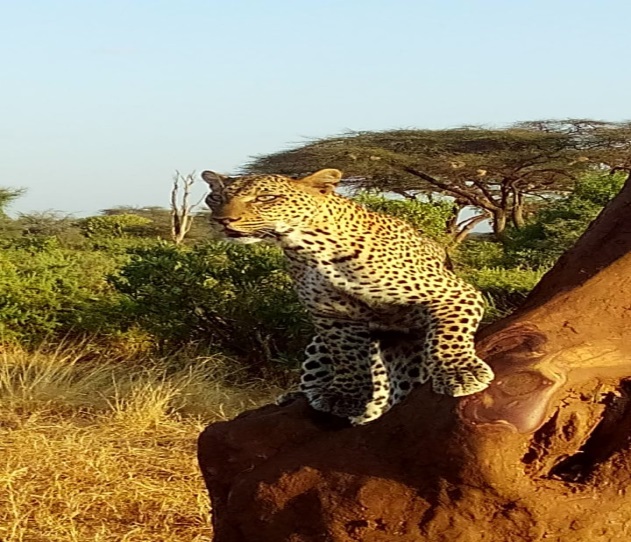
This cute female leopard has been making us proud every day of the week. Mainly found in the area of the now all whether white river. She has been pausing for every tourist for unique photos. Surely if it was a fashion contest she would easily walked away as overall winner. She is our Miss tourism Samburu.


She has been very lucky with kills. More than once we have found her enjoying the meat on top of the tree. This has only made her look prettier. One of the evenings she showcased how she does by bring down a full grown up he-impala


 The Lucky Cheetah


Sharing the same territory with oryx, impalas, grant gazelles and other antelopes, these cheetahs had plenty of time hunting the smaller antelopes. Only half of the chases, which last from 20 - 60 seconds, are successful. They are found mostly in these partially open savannas because they rely on tall grasses for camouflage when hunting. They are diurnal (more active in the day) and hunt mostly during the late morning or early evening.
Unlike other big cats, cheetahs cannot roar. However, they can purr on both inhale and exhale, like domestic cats!

Did You Know?
When cheetahs are running, they use their tails to help them steer and turn in the direction they want to go, like the rudder of a boat.

27 March, 2019

A Wildlife-Haven in Samburu

The reserve in Kenya’s northern arid lands is one of Kenya's best-loved wildlife reserves. In complete contrast to the rolling savannah grasslands of the Maasai Mara, Samburu is filled with hills and dry riverbeds (luggas) with the Ewaso Nyiro River meandering along groves of the iconic doom palms. It has a wealth of wildlife with lions, leopards and cheetahs hunting down antelopes, zebra and other herbivores. The elephants are one of the longest studied in Africa.

Samburu Intrepids is the jewel in the reserve. With its experienced guides you will be able to see much of what the reserve has.

Lion of Samburu
These lions will rest after hunting down the rare Grevy’s zebra that is only found north of the equator. It may look easy but hunting is a strenuous exercise.


Did You Know?

Both male and female lions roar?
A lion’s roar can be heard from five miles away. Lions are also the second largest living feline after the tiger.

Leopards


Leopards climb to higher spots to look for prey. They will then prepare for a kill. One would think this one is posing for a photo shoot.

Did You Know?
Leopards are very agile, and can run at over 36 miles per hour, leap over 20 feet and jump up to 10 feet.

Elephants


Elephant calf suckling
Did You Know?
Mating Season: Mostly during the rainy season.
Gestation: 22 months.
Litter size: 1 calf (twins rare).
Calves weigh between 200-250 pounds at birth. At birth, a calf's trunk has little muscle; 
therefore it will suckle through its mouth. It takes several months for a calf to gain full control of its trunk.


Grey-headed Kingfisher (above) and Palm-nut vulture

Birds
Samburu boasts over 350 species of birds.

Samburu People
They are one of the few tribes who have maintained their culture. They are nicknamed the butterfly people because of their bright coloured attire as seen in the picture.


The doum palm is iconic Samburu.


Top: Lioness and elephant

Above: Elephants against a doum palm in Samburu after the rains. That’s why the grass is green.

Written by Maurice Njeru, Manager Samburu Intrepids.


24 August, 2018

Adventure at Samburu!

Elephants

Elephants form deep family bonds and live in tight matriarchal family groups of related females called a herd. The herd is led by the oldest and often largest female in the herd, called a matriarch. Elephants are extremely intelligent animals and have memories that span many years. It is this memory that serves matriarchs well during the dry seasons when they need to guide their herds, sometimes for tens of miles, to watering holes that they remember from the past. They also display signs of grief, joy, anger and play.
The mating season for elephants is mostly during the rainy season and the gestation period is 22 months.


A lone elephant heading to the bush. The elephant was the only one around this area. More elephants where spotted in the distance distance.


River Ewaso Nyiro which means ‘river of brown water’ is the only source of water for wildlife in Samburu National Reserve. This season it has little water in it. The elephants were seen at the river, taking their time to quench their thirst. A lioness walked past them for a drink also.


During the dry season, the flat top acacias bear seed pods which are healthy for livestock and wildlife. Elephants enjoy the acacia seeds after quenching their thirst at River Ewaso Nyiro.
Compiled by Chris Letur, Camp naturalist

02 August, 2018

Nanai the Lion


The Koitogo pride of lions in Samburu National Reserve is named after the famous hill in the heart of the reserve. There are 21 lions in the pride. On a recent evening game drive we saw one of the females from the pride called Nanai (a Samburu word meaning mine) and her cubs aged five months walking on the road.


Nanai came out of the bushes followed by her cubs and walked majestically along the road.


We got some beautiful photos of the cubs. To my surprise the cubs were not shy of the vehicle. Instead they stared at us as if they were also taken by surprise.


We followed Nanai and her cubs for a while until we reached the banks of the Ewaso Nyiro River which is the main source of water in this dry semi-arid land. That's when we realized that Nana’s intention was to take her cubs to drink water. After drinking, they came up the river bank. While the cubs played, Nanai looked around for prey.


She then let the cubs go in to the bushes as she hung around the banks. Nanai is one of the famous female’s seen most of the time around the reserve. She is about nine years old and really struggles to bring up her cubs. We wish her plus her new cubs all the best.

Written by Justus Kisoo | Samburu Intrepids Camp | Heritage Hotels Ltd.  

29 June, 2016

Samburu Safari Diary

ELEPHANT DUSTING
At Samburu National Reserve in northern Kenya, elephants are often seen giving themselves a dust shower. Using their trunks, they inhale the dust and blow it out forcefully. It’s quite an amazing thing to see. The dust serves as a sunscreen, keeps the animal cool and insects at bay.

Wild pigs also roll themselves in dust to protect themselves for the same purpose.

Klipspringers Spotted


Klipspringers spotted recently at Koitogo hill in Samburu National Reserve proved to be exciting for our guests who had never seen this antelope before.  My mission was to spot a leopard but the klipspringers proved to be equally interesting.


Klipspringers are small antelopes that live in rocky places. They are well-adapted to their environment. Their fur has hollow shafts that act as shock absorbers should they slip off the rocks and their hooves are pointed like a ballerina’s to hop on the rocks. They pair for life like the smaller dik dik.


Lions
This week we had a great sighting of Lguret, one of the oldest males in Samburu and Buffalo Springs national reserves with his cubs. Male lions will babysit the cubs while the lionesses are our hunting.


Young males will usually kill any cubs they find in a pride when they become the dominant male.  They want to pass their genes on and mark their territory.

Wild dogs
An endangered species, Africa wild dogs are seen in the reserve during the dry months of July and August when water is available inside. The picture was taken a few meters from the camp.


Ruppell's Griffon Vulture
When soaring, this magnificent bird can spot a carcass nearly 10 kilometers away! Known to be the world’s highest flying bird, in 1973 one collided with an airplane off the Ivory Coast. The plane was flying at a height of 37,000 feet, which is higher than Mount Kilimanjaro at 19,340 feet high!
Image Source Mother Nature Network
37,000feet asl is also the height at which a human would pass out from lack of oxygen. The vulture doesn't face this problem because it has developed a particular type of haemoglobin, making their use of oxygen more effective.

Long Crested Eagle
The long crested eagle is found in sub-Saharan Africa. It’s one of my favorite birds of prey among the 300-plus species found in the reserve.

Dairy of a Naturalist by Jelly Loloju, driver guide at Samburu Intrepids Camp

27 February, 2015

BIG CAT Report - Samburu Intrepids Camp

At 4pm recently, we arrived at the Daraja bridge on the Ewaso Nyiro River in the heart of the Samburu National Reserve. It is the elephants’ main crossing area. There were no herbivores around and I slowed down to look for tracks of animals. 

There were lots of tracks leading away from the river - zebras, oryx and impalas all running in the same direction.   

I had no doubt that the lions were close. I drove along the river and immediately saw Nanai and Nabulu, the two lionesses with their five cubs lying by the river waiting for the prey.   

Back at the camp, I received more news that more lions were sighted with a kill. It was of a Grevy’s zebra. 

 Sebastian our driver-guide explained that Lguret, the dominant lion collaborated with Nachupai, one of the oldest females in the reserve to kill a young Grevy’s zebra. It took them less than three hours to devour the zebra. 

After the feast, Lguret took refuge under a shade while Nachupai lay by the carcass to protect it from vultures.

       
Report and pictures by Steve Tilas – Head Safari Guide, Samburu Intrepids Camps.
©Heritage Hotels Ltd, Kenya. http://www.heritage-eastafrica.com/

10 September, 2014

RARE SIGHTING AT SAMBURU NATIONAL RESERVE

A few days ago while on a game drive we saw hundreds of vultures relishing a freshly killed male impala. At first, I thought it was a leopard kill but there was no sign of the impala having been strangled by a leopard.

Vultures feed on carcasses, they do not make a kill of their own.  We were very eager to find out who killed the impala. So we switched off the car engine and waited. 


I only took three pictures then I saw a wolf-like animal emerging from the bush. It was a wild dog!
The impala had been hunted by a pack of wild dogs.

When we were children we were told that wild dogs only eat animals alive and when the animal falls down, the wild dogs leave it. I have also seen wild dogs hunting their own prey where they finish it immediately.


  • African wild dogs live in packs. The Alpha male leads the team in a hunt.
  • African wild dogs take care of the young for about 12 -14 months –or for as little as six months if all of the previous young die.
  • The gestation period is between 60 and 80 days. Pups are born in dens.
  • A wild dog is adapted to long-distance running at high speeds,  of up to 66 km/hr for 10 to 60 minutes, and over great distances (at about 50km/hr. for 5.6km).  Nearly 80 per cent of all wild dogs hunts end in a kill.
  • Members of a pack vocalize to help coordinate their movements.
  • They take good care of their young. After a successful hunt, the hunters will regurgitate meat for those that remained at the den.
  • To hunt larger prey, wild dogs use a closely coordinated attack, beginning with a rapid charge to stampede the herd. One wild dog then grabs the victim's tail, while another will latch on to the upper lip or nose, and the remainder attempt to disembowel the animal.
  • The male wild dogs usually perform the task of grabbing the prey by the nose.
  • The African wild dog is an endangered species due to habitat loss and poaching. It uses very large territories (so can persist only in large wildlife protected areas), and it is strongly affected by competition with larger carnivores that rely on the same prey base, particularly the lions and hyenas.


Report by Steve Tilas – Safari Guides, Samburu Intrepids Camp.
©Heritage Hotels Ltd, Kenya. http://www.heritage-eastafrica.com/

05 August, 2014

A Wildlife Preview Of A Game Drive In Samburu National Reserve

The whole land has turn to be dry and we are deep in the dry season in Samburu and further North. Most of the shrubs, trees and grass are completely finished in some areas. The life giving river Uaso Ngiro is also too low and people within region are also struggling to graze their animals where there is little pasture. There is a lot of migration taking place---- all in search of water and pasture.   

In the reserve, our safaris have been enjoyable and successful in terms of big cats sighting. Samburu’s large carnivores – lions, leopards and cheetahs – are coping very well. Our guests see cats making kills almost daily. 


The 5 cubs and 2 females are eating a full grown warthog which was just killed by Nanai (mother of three). We have also recorded Namunyak has been limping on the right foreleg for quite some time now.

Due to lack water in the region, lots of prey concentrates within the water areas and the same makes it easier for carnivores to find the prey coming to the river. In this time therefore is the best time to see the predators because they spend more time concentrating along Uaso Ngiro River, and are also more lethargic, making it easier for carnivores to ambush them.   

This family has been most of their time it’s in the reserve near Koitogo mt.. Their hunting has been successful due the number of warthogs, Zebras, Oryx which has increased in the park. The family has many a times with warthog kill and many other time killing Zebras and other game.


Cubs eating Zebra carcass

Few other rare animals has been recorded in the reserve including kudus (lesser and greeter) 5 lesser kudus which was amazing, over 300 Grevy’s Zebras, lots of impalas, waterbuck, giraffes, grant gazelles plus of course the big cats.


Wild dogs have been recorded in the reserve but they are not regular visitors.  

The female lioness and her three cubs visit the river banks of Uaso Ngiro River during the afternoon hours to cool down their bodies from the intense high temperatures which are recorded during the day. The cubs are fond of eating the grass at the river banks to induce puking which is a natural way of cleaning their stomach from impurities eaten earlier from its prey.   

The female Cheetah and her two cubs are very patient and hopeful animals when it comes to hunting expeditions. Despite their hunger strikes, they are able to focus and strategize on getting their next prey. The cheetah converts its hunger strain into power and agility into hunting for its prey. It never gives up hope. The female Cheetah has a greater responsibility of getting a prey this is due to her cubs that have no greater or minimal experience and ability on hunting for its prey.


The cheetah has a remarkable reputation of capturing its prey after a day as compared to the other cats which spend almost two to three days towards capturing their next meal. Cheetahs are not heavy eaters but there are known for their speed both in eating and running as compared to lions and leopards. This can be explained well by their streamlined body structures.Leopards are good tree climbers due to their muscles on both the front and hind legs. The female leopard at Samburu National Reserve which was spotted on top a tree during evening hours and later on, the following day in the morning at the hills was considered to be leading a solitary life, which in general it’s their nature. They protect and monitor their territory from other predators.


The leopard has a good eye sight capability when it comes to sighting of their prey on top of trees. They can stay up to more than half an hour focusing and strategizing on how to hunt at the marked prey. Sometimes lions depend on them for their survival whereby they wait for leopards to kill and the run to snatch the kill. This has been very common in Samburu whereby young male lions hide near leopard’s territories to try their luck.


The Reticulated Giraffe, Water back, Impalas, Oryx, Somali Ostrich, Grevy’s Zebra and the dik diks are all the prey of the big Cats that are found in Samburu National Reserve.


Impalas numbers have increase for the last five years and that made it easy for the lions to hunt them. Oryx are also preferred due to the size which can fill the whole pride at once. The Water Bucks meat has got a lot of fatty tissue around their muscles thus it’s the least of the big Cats favorite prey. We happen to meet the Gerenuk feeding on small tree shrubs standing on its two feet and with its long neck, which is its adaptive feature and means of survival in the wild which is a major advantage among the family of herbivores game animals.


To mark the end of the days adventurers expedition we happen to meet “Pumba” ( a warthog) and his fellow brothers enjoying themselves before they become their predators meal at sunset…'You Only Live Once’…I heard them say.

   
Report by Steve Tilas and pictures by Jelly Loloju – Safari Guides, Samburu Intrepids Camp.
©Heritage Hotels Ltd, Kenya. http://www.heritage-eastafrica.com/