Showing posts with label golf. Show all posts

25 April, 2014

Wildlife Thrives In Naivasha


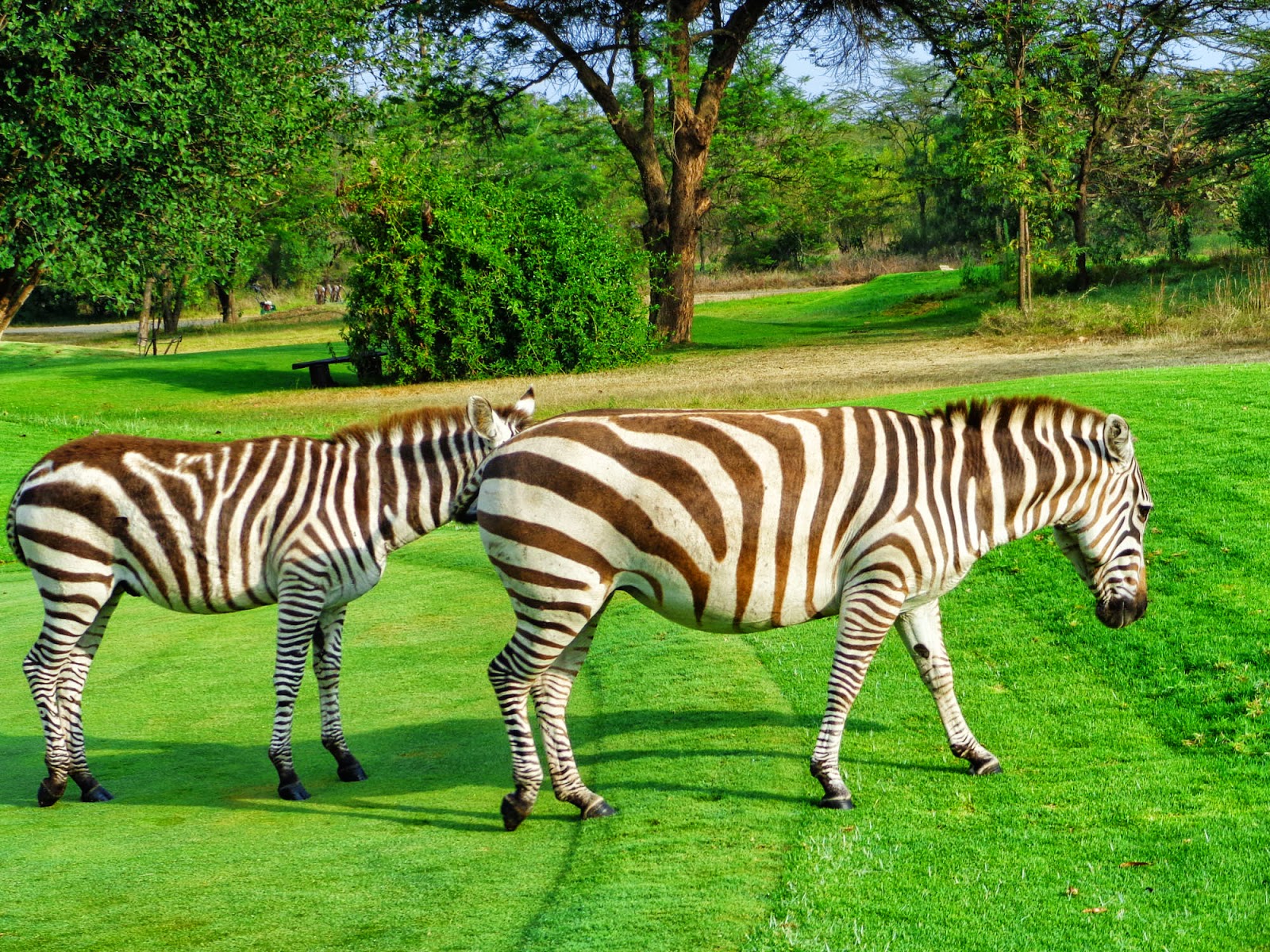
All five zebras at the Great Rift Valley Lodge and Golf Resort are in good shape. They love the golf course and they have to be constantly shooed away for they love to wallow in the bunkers and destroy the greens with their hooves.


Pili, who is 14 months old is the only zebra who is injured. He hurt his right hind leg recently and was treated by KWS vet. He is improving but limping and although he does not suckle anymore, he follows his mother around.

The Migration In Naivasha

The Maasai Mara is famous for wildebeest but now on Crescent Island in Naivasha, there are herds of them and they move on the Island just as they do between Mara and Serengeti.


Crescent Island is also home to many other plains game like impalas, zebras, Grants’ gazelle, Thomson’s gazelle, waterbuck and others. It’s all the more reason to visit it while you’re staying at the Great Rift Valley Lodge and Golf Resort.


Crater Lake
Crater Lake near Lake Naivasha in the Great Rift Valley is home to a diversity of plains game and birds. When they are not nesting at Lake Natron in Tanzania, flocks of flamingos fly in to feed on the rich algae.


The lake is only 18 kilometers from the Great Rift Valley Lodge and ideal for day excursions. It’s great for hiking. A walk around the rim of the crater takes two hours. From the southern part of the crater you can see Lake Naivasha and Lake Oloiden which are just 100 meters apart. This is a game sanctuary that is worth visiting for the panoramic views and wildlife.


Heritage Hotels (Kenya) manages The Great Rift Valley Lodge and Golf Resort in Naivasha, just an hour an a half's drive from Nairobi. The lodge is famous for one the longest holes in Kenya - the par 5 -  17th ‘signature’ at 598 metres (654 yards)!
 ©Heritage Hotels Ltd, Kenya.

13 July, 2012

A Topic For Co-evolution & Interesting Insects


At the Great Rift Valley lodge the Acacia drepanolobium is a common plant. Its thorn-filled branches have evolved over the millennia to avoid being browsed on by the giraffe which evolved to have prehensile tongues to be able to pick acacia leaves between the thorns. The A. drepanolobium, went one step further and evolved to have galls on the edge of the thorn. These galls provide shelter for the cocktail ants which return the favour by protecting the acacia from being browsed on by the giraffes. When the giraffe sticks out its tongue to gather the leaves on the branch, the cocktail ants rush out of the galls and produce an irritant fluid to keep the giraffes at bay.


This is an example of co-evolution where two (or more) species affect each other’s evolution. So for example, an evolutionary change in the morphology of a plant might affect the morphology of the herbivore that eats the plant, which in turn might affect the evolution of the plant, which might affect the evolution of the herbivore...and so on.

This is a case of an exclusive “matches” between a plant and an insect even though pollination is not involved. The hollow thorns are the exclusive nest-site of the ant which drinks acacia’s nectar. The ants are not just taking advantage of the plant but also defending the acacia against the herbivores.

This system is probably the product of coevolution: the plants would not have evolved hollow thorns or nectar pores unless their evolution had been affected by the ants; and the ants would not have evolved herbivore defense behaviors unless their evolution had been affected by the plants.


An Interesting Insect on the ground

Jean Michel Kersaudy from France is a regular guest at the Great Rift Valley Lodge and is researching on the Harvester ant (Messor cephalotes) found on the grounds of the lodge and the golf course, much to the chagrin of the green keepers.

The harvester ant is a huge red colored seed-collecting ant found in East Africa.
The objective of Kersaudy’s research is to identify the type of grazing insects that are laying the golf course bare - in other words contributing to its land degradation. Land degradation in this context is the removal of grass on their trail.


The second objective is to determine the extent to which grazing insects are contributing to golf degradation at GRVL.

The harvester ant species Messor cephalotes use of formic acid produced in their glands to clear the grass.

Ant Antics
  • After separating the seeds from husks, the ants remove the husks and put them outside their nests. 
  • They have a queen but no king because the king dies immediately after mating. Mating takes place during the long rain season.

Report By: Daniel Kilonzo, Senior Naturalist, Great Rift Valley Lodge and Golf Resort

Heritage Hotels (Kenya) manages The Great Rift Valley Lodge and Golf resort in Naivasha, just an hour an a half's drive from Nairobi. The lodge is famous for one the longest holes in Kenya - the par 5 -  17th ‘signature’ at 598 metres (654 yards)!
 Report and pictures by Daniel Kilonzo, Resident Naturalist at GRVL ©Heritage Hotels Ltd, Kenya.http://www.heritage-eastafrica.com/ 

Great Rift Valley Lodge Goes Foal!

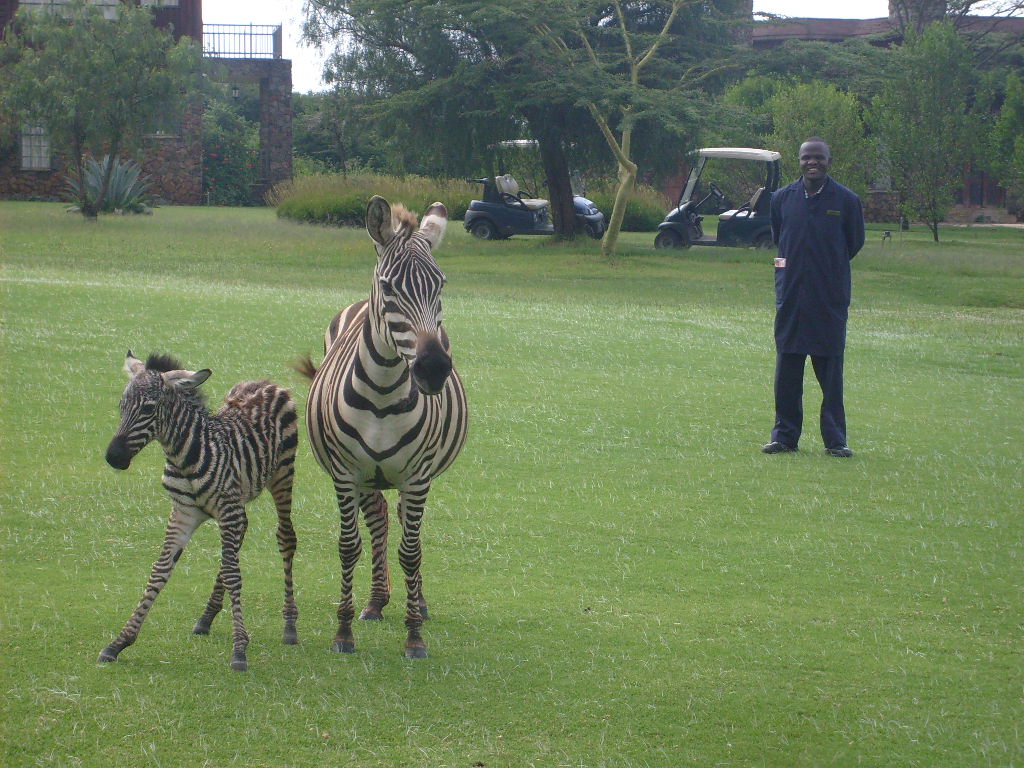
On the morning of 9th July 2012, by the second hole on the golf course a zebra foal was born. The zebras were introduced at the Great Rift Valley Lodge four months ago and now we have two mature females, one sub-adult male and one foal.


Zebras have a long gestation period of one year which helps the young one to fully develop in the womb and be able to flee predators a few minutes after birth. The mother eats the afterbirth to avoid attracting predators. However there are no predators at the Great Rift Valley Lodge. A zebra foal identifies its mother by sight. After birth, the mare and the foal spend time away from the herd – the theory is that the foal memorizes his (or her) mother from her stripes. The foal will stay close to the mare for a year.


Report By: Daniel Kilonzo, Resident Naturalist, Great Rift Valley Lodge and Golf Resort


Heritage Hotels (Kenya) manages The Great Rift Valley Lodge and Golf resort in Naivasha, just an hour an a half's drive from Nairobi. The lodge is famous for one the longest holes in Kenya - the par 5 -  17th ‘signature’ at 598 metres (654 yards)!
 Report and pictures by Daniel Kilonzo, Resident Naturalist at GRVL ©Heritage Hotels Ltd, Kenya.http://www.heritage-eastafrica.com/