Overview
It’s raining every afternoon in Maasai Mara but despite that the rivers are still low. The plains are already full of tall red oat grass especially between the Talek and Olare Orok rivers and also in the southern part of Mara Intrepid camp and the Possee Plain all the way down to the border of Mara and the Serengeti.
The area between Rhino Ridge and Paradise Plain to the main crossing at Mara River is also covered with tall grass, forcing all the herbivores to seek refuge in places with short grass in the eastern and northern part of the Ridge.
The long rains were not wide spread this year, so some parts of the reserve and its adjacent areas are drying up and hence forcing the herbivores to move into the reserve early than expected. The Loita herds of wildebeest and zebras are here, roaming from Musiara Marsh to the game reserve border. Other places with high concentration of plain game are west of Lookout Hill, across Talek River south of Mara Intrepids Camp and Maji-ya-Eland, west of Mara Intrepids Camp and Maji-ya-Fisi and Shamarta and Paradise Plain.
Big Cats Sightings
Lions
Some of the prides are still enjoying the herds of wildebeest, especially the Marsh Pride, the Ridge Pride and the Olkiombo Pride.
The Marsh Pride is still intact with their old males.
The Ridge Pride has separated into four groups of different numbers occupying small sections of their territory. Between Olare Orok and Intiakitiak there are 32 lions including Notch and his sons. A group of four lionesses and eight cubs of seven months are found between Mara Intrepids Camp and Rekero Camp going further to the junction of Mara River and Talek River. Notch and his sons are in charge of the group.
The Olkiombo Pride has split into three groups and has increased to 42 lions.
One group of 12 individuals which in the last three years had moved to the Olare Orok Conservancy is back in the game reserve occupying Chuvi-Chuvi along Intiakitiak River. It has eight cubs of three years old and four lionesses. It looks like Notch and his four sons might take over this pride as they have been seen trailing the pride.
Four lionesses, four sub-adults and three cubs from the Olkiombo Pride are between Fig Tree Camp and Mara Intrepids Camp. When Cheza, Sala and Junior took over Maji-ya-Fisi Pride, a group of three lionesses and nine cubs of two years followed them. Now they have six cubs of nine month and three males which make a total of 22 members.
Leopards
Sadly Olive lost one of her two cubs between Mara Intrepids Camp and Double Crossing. She has been seen roaming with Kayoni and her surviving one-year-old cub. Pacha is wandering along Olare Orok up to Rhino Ridge and marking his territory.
Big Boy has not seen of recent but when last he was seen with a badly wounded back leg.
Cheetahs
The three brothers moved to OOC with Shingo the mother of six cubs and three junior brothers south of Mara Intrepids Camp towards Lookout Hill.
Two young expectant females are at Bila Shaka and Topi Plain. Saba and Alama who were at Olkiombo have moved west of Mara Intrepids Camp.
*Did you know the Disney movie, African Cats was shot near Mara Intrepids and Explorer camps? Well now you know!
Report by Dixon Chelule, Assistant Head Guide Mara Intrepids Camp and Paul Kirui, Head Guide, Heritage Hotels. Pictures by Dixon Chelule and Paul Kirui.
24 June, 2011
Excellent Game Viewing in Samburu
Recently, guests guests at Samburu Intrepids were treated to an exciting game drive.
As we crossed a small creek opposite Serena Lodge, we came across a pack of the African wild dogs, one of the most endangered canine species in Africa. The African wild dog has a unique way of hunting. The pack will chase the prey until it is exhausted.
Within seconds, the pack had brought down a male dik dik….and all fought to have a piece of the meat.
Soon after feasting on the dik dik, the pack of 14 climbed a hill to rest.
Facts on the African Wild Dog
Unique creatures seen on a game drive
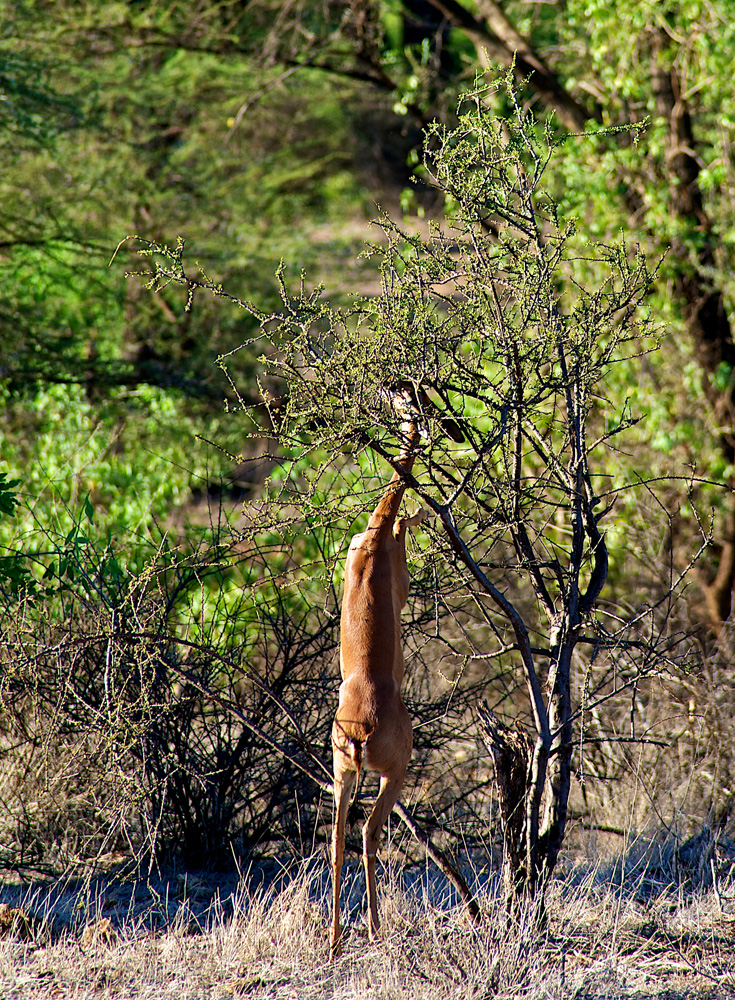
Gerenuks, derived from the Samburu name meaning 'giraffe antelopes' browse in the morning and evening. The gerenuk is one of the 'special five' of Samburu - the others are the Somali ostrich, reticulated giraffe, Grevy's zebra and Beisa's oryx.
They stand on their hind legs to reach the shrubs.
Cheetah hunt caught on camera!
North of Samburu Lodge we saw a cheetah and her two cubs. We followed them patiently as they looked a bit hungry, and our hunch was rewarded pretty soon - a hunt was just about to begin!
Target in sight - a dik dik (this is one of the smallest antelopes, found only in the northern parts of Kenya).
The dik dik tried its best to flee for safety but in vain - he didn't stand a chance. Out flanked, out run and over powered by the fastest predator on land, the battle was over before it begun! The mother cheetah was also using the dik dik to train her cubs how to hunt because as soon as they are adults they have to hunt on their own. She also ate last, maybe recognising that they were tired and she - matrimonially - was still looking out for them.
Fun facts about dik diks:
Habitat: Dik diks live mostly in semi arid regions with low bush along dry, rocky stream beds
Behavior: Dik diks form monogamous pairs in that reside in fixed territories. They mark their territory with dung deposits and with secretions from the preorbital gland.
Sight, scent and hearing are well-developed and they are very alert.
They respond to the alarm calls of other animals. When in danger they hide.
Report by Francis Lenyakopiro, Culturalist / Naturalist at Samburu Intrepids Club. Pictures by Francis Lenyakopiro, Barbara Minishi and Ndeithi Kariuki.
As we crossed a small creek opposite Serena Lodge, we came across a pack of the African wild dogs, one of the most endangered canine species in Africa. The African wild dog has a unique way of hunting. The pack will chase the prey until it is exhausted.
Within seconds, the pack had brought down a male dik dik….and all fought to have a piece of the meat.
Soon after feasting on the dik dik, the pack of 14 climbed a hill to rest.
Facts on the African Wild Dog
The African wild dog is also called the 'Cape hunting dog' or 'painted dog'. The dog's Latin name means "painted wolf," referring to the animal's irregular, mottled coat. Each animal has a unique coat pattern, and all have big, rounded ears.
It typically roams the open plains and sparse woodlands of sub-Saharan Africa. These long-legged canines have only four toes per foot, unlike other dogs, which have five toes on their forefeet.
African wild dogs live in packs that are usually dominated by a monogamous breeding pair.The female has a litter of two to 20 pups, which are cared for by the entire pack. These dogs are very social, and packs have been known to share food. They also help weak or ill members. Social interactions are common, and the dogs communicate by touch, actions, and vocalizations.
African wild dogs hunt in formidable, packs of six to 20 (or more) animals. Larger packs were more common before the dogs became endangered. Packs hunt antelopes and will also tackle much larger prey, such as wildebeests, particularly if their quarry is ill or injured. The dogs supplement their diet with rodents and birds.
As human settlements expand, the dogs have develop a taste for livestock, though significant damage is rare. Unfortunately, the dogs are often hunted and killed by farmers in revenge for killing their livestock.
African hunting dogs are endangered. They are faced with habitat loss and are also susceptible to diseases spread by domestic animals.
Unique creatures seen on a game drive
Gerenuks, derived from the Samburu name meaning 'giraffe antelopes' browse in the morning and evening. The gerenuk is one of the 'special five' of Samburu - the others are the Somali ostrich, reticulated giraffe, Grevy's zebra and Beisa's oryx.
They stand on their hind legs to reach the shrubs.
These antelopes live in herds of six to 10 animals with one territorial male and females.
Orange breasted parrot. beautiful ain't he?
Bush Buck.
Vulturine guine-fowl - only found in northern Kenya
The desert rose - pretty but poisonous.
We came across this fella near Samburu Intrepids. He was about 2 and a half metres long!
Menacing look.
Cheetah hunt caught on camera!
North of Samburu Lodge we saw a cheetah and her two cubs. We followed them patiently as they looked a bit hungry, and our hunch was rewarded pretty soon - a hunt was just about to begin!
Target in sight - a dik dik (this is one of the smallest antelopes, found only in the northern parts of Kenya).
The dik dik tried its best to flee for safety but in vain - he didn't stand a chance. Out flanked, out run and over powered by the fastest predator on land, the battle was over before it begun! The mother cheetah was also using the dik dik to train her cubs how to hunt because as soon as they are adults they have to hunt on their own. She also ate last, maybe recognising that they were tired and she - matrimonially - was still looking out for them.
Fun facts about dik diks:
Habitat: Dik diks live mostly in semi arid regions with low bush along dry, rocky stream beds
Behavior: Dik diks form monogamous pairs in that reside in fixed territories. They mark their territory with dung deposits and with secretions from the preorbital gland.
Sight, scent and hearing are well-developed and they are very alert.
They respond to the alarm calls of other animals. When in danger they hide.
Report by Francis Lenyakopiro, Culturalist / Naturalist at Samburu Intrepids Club. Pictures by Francis Lenyakopiro, Barbara Minishi and Ndeithi Kariuki.
28 March, 2011
5-Day Mount Kenya Trek - In Pictures
We promised pictures of the trek. Here they are. They are chosen form the different people who took part in the expedition. Hope you enjoy them. Aberdare Ranges, top of the picture. Nyeri is on the farthest left and Nanyuki farthest right. Naru Moru, the group's starting point is in the middle of the picture on the floor of the Rift Valley. The group poses in the historic Mau Mau caves high up in the mountain. This is where Kenya's freedom fighters would hide during the liberation struggle in the early 1950s. |
25 March, 2011
How much can a Samburu lion eat a day?
Welcome to 2011. After the 2009-2010 severe drought followed by the massive floods, the Uaso Ng’iro River has dried up again!
The 2009 drought was the worst in Northern Kenya and the river was dry for nine month.
The river divides the three Game reserves – Samburu, Buffalo Springs and Shaba. Shaba is the driest, almost barren; Buffalo Springs is the least arid and mostly with rolling plains while Samburu is more rugged with rocky outcrops. The reserves are on the southern end of the range for birds of the arid northern bush. There is plenty of bird life in the Acacias and Doum Palms along the river banks. The shade provided by the trees also makes them a favorite place for elephants during the midday sun.
The Isiolo River, which runs through Buffalo Springs and empties into Uaso Nyiro is still flowing. It originates from the springs and has permanent water. It’s the best place to find Kingfishers, and crocodiles. Stretches of the Isiolo River with overhanging grass are good for the small herons.
Wild Dogs
The wild dogs are back! On 3rd March a pack of 16 (11 adults and five young ones) was spotted about six kilometers to the West Gate in Samburu National Reserve. The same pack was later spotted hunting near Observation Point in Buffalo Springs National Reserve. The puppies looked healthy meaning the adults are not having a hard time hunting down prey.
Lions
I took this picture in February 17 in Samburu National Reserve when our guests Alex, Collins, Holly and Mary saw the above two females from the Koitogo pride. They were very excited to spot them before they left for home.
We followed these two lionesses for five minutes, and our patience was rewarded when the alpha female caught a sleeping gerenuk fawn (giraffe-neck antelope)! It was an amazing sighting. We followed the female with the kill through the toothbrush trees near the Old Samburu airstrip where the whole pride was and we saw five more lions running towards the female with the kill. It was before breakfast and we watched the pride for 15 minutes before we drove back to the camp. Excitement is never far off in Samburu due to its dense vegetation.
Baboons
Baboons are opportunistic eaters and fond of crops. They are the bane of many African farmers. The baboons eat fruits, grasses, seeds, bark, and roots and have a taste for meat. They eat birds, rodents and even the young of larger mammals, such as antelopes and sheep. Baboons have large troops, composed of dozens or even hundreds of baboons, governed by a complex hierarchy that is fascinating, especially on game drive. Males use physical power to dominate rivals. Baboons spend endless hours carefully grooming one another to remove insects and dead skin
How much can a lion eat a day?
Lions in Samburu will eat every three to four days and can go without food for more than a week. This means that the average "daily" intake of food in about 5 to 7 kgs. A lion can eat up to 25% of its own body mass when needed. The average lion will normally only kill enough to sustain himself – which is about 15 animals per year. There are incidents of young lions killing needlessly, picking on small and weak animals just for the sake of killing.
Samburu is world famous for its famous five; the long-necked gerenuk antelope, Beisa's oryx, reticulated giraffe, Grevy's zebra and Somali ostrich. Our leopards are difficult to spot but with our expert guides, one will think the Samburu leopards know us. The Koitogo Mountain has five leopards while one of the females among them has a cub. She lost the second cub last year. Our leopards have not been named but we can recognize some of them from their behaviour.
The Uniqueness of Samburu
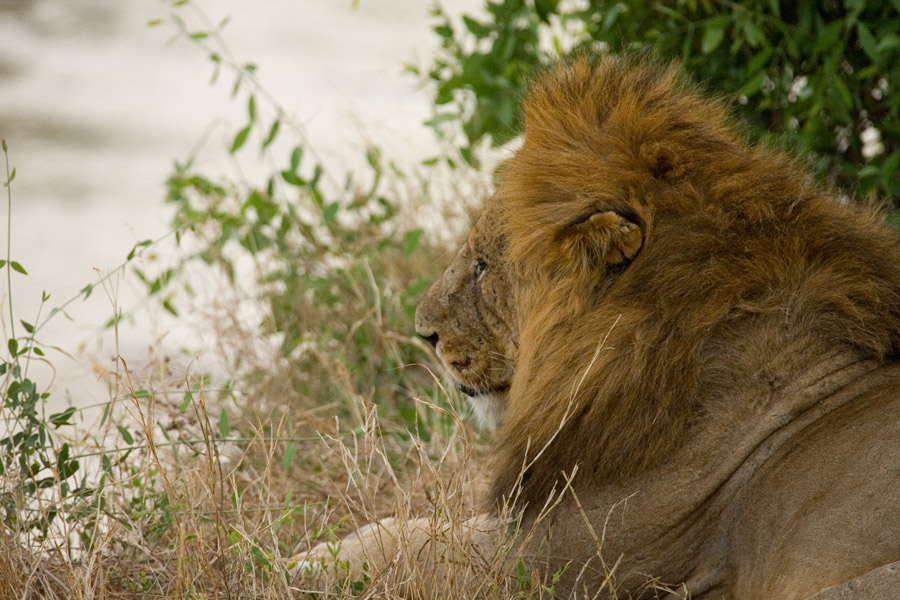
The mane of the adult male lion, unique among cats, is one of the most distinctive characteristics of the species. It makes the lion appear larger, providing an excellent intimidation display; this aids the lion during confrontations with other lions. The lions in Samburu have shorter manes compared to their Mara cousins. They are are paler in colour, which is an adaptation to this arid land.
![]() |
| Gerenuk antelope |
![]() |
| Reticulated giraffes with Beisa's oryx |
![]() |
| Grevy's zebra |
![]() |
| Somali ostrich |
In Samburu, I've always had great luck spotting leopards while taking guest on game drives. Once a leopard climbed into a tree while we watched. I recommend Samburu for leopards
Leopards living in desert areas tend to be pale yellow in color. Leopards inhabiting grasslands are a deeper golden color.
Northern Kenya is a huge expanse of scrub desert, bisected by a few life saving rivers. A true wilderness, this area of Kenya is very sparsely populated, and game patterns have been little affected by humans.
Steven Tilas, Resident Naturalist, Samburu Intrepids Camp ©Heritage Hotels Ltd
Subscribe to:
Posts (Atom)