07 March, 2011

5-Day Mount Kenya Trek


Peter Wandiriani, an Heritage Hotels' eCommerce Executive is taking part in a gruelling 5-day trek of Mount Kenya from Naru Moru, a sleepy town along the main Tumu Tumu - Meru road through the mountain.The group of 16, accompanied by two guides shall be climbing from the east to Point Lenana 4,985 metres (16,366ft) above sea level and out westwards at Chogoria.

Over the 5-day period, we shall be updating this blog with their progress, and after the trek we shall post pictures of this great adventure.

The planned itinerary is:

Day 1,March 02
You drive to the north of Nairobi through pineapple and coffee plantations to the slopes of Mt Kenya which normally take 4 hrs.You will have your picnic lunch at Naru-Moru gate and then start walking through rain forest for 3 hrs to Met Station 3,048m,dinner/overnight.

Day 2, March 03
After breakfast,the whole group will climb higher than Met Station to gain the altitude and acclimatisation then return to the camp,dinner/overnight.

Day 3, March 04
After breakfast your climb continue to Mackinders camp which is approximately 5-6 hrs,14km.You will walk through the vertical bog and  tussock grass.At this point the main peaks provide a spectacular view of Batian and Nelion, continue walking through Teleki Valley,dinner/overnight at Mackinder's camp 4,300m.

Day 4, March 05
The ascension of the summit of Point Lenana begin before dawn at 3.00 oclock to ensure time to view the sunrise from the peaks.The walk takes 3 hrs to Point Lenana 4,985m ,third highest peak.,then descend to Mintos hut for
breakfast,dinner/overnight.

Day 5 March 06
After breakfast continue descending down to Meru Mount Kenya Bandas above Chogoria, following the Gorges Valley. It will take 5 hours to reach the chogoria bandas,where you will lunch and then you drive down through the bamboo and indigenous forest passing Embu to Nairobi.


Day 1:

Peter Wandiriani] and the Kobo Safaris crew of 16 strong plus their 2 guides have just come from acclimatisation near Mackinder's Camp some 3,800 metres above sea level on Mt Kenya. 

They are now back at camp at the Met station. The group sets off tomorrow morning at 0630 hrs for an overnight at Mackinder's Camp, which is 4,200m above sea level. The temperature at Mackinder's camp is around -1ÂșC.

Day 2:

08.00am

The group left the Met Station (-0.174193,37.147093) at dawn for a six hour uphill ascent of 1,200 metres above sea level through heath and moorland belt to Mackinder's Camp. The group has just completed the rain forest. Weather conditions are favourable -it's  hot and the group is in great cheer.  

They are using the Naru Moru route, favorite for many climbers because it's less steep and takes only 3 days to reach point Lenana.
Point Lenana.
Picture courtesy of Chris 73 / Wikimedia Commons
Mount Kenya has several peaks; Point Lenana, which is 4,985 metres (16,355 ft), Point Nelion at 5,188 metres (17,021 ft) and the highest Point Batian at 5,199 metres (17,057 ft). See more of Mount Kenya map here http://bit.ly/hv97W0

They are currently at 3,590 metres above sea level.  From their locale, they command a 180 km radius vista, from the Aberdares Ranges, the Laikipia plains covering all the way from Mweiga in Nyeri to Lewa Downs, and all the way to the Isiolo hills. 


13.04pm 

Our trekkers have made good ground. They are just over the Teleki Valley (named after the European explorer, Count Samel Teleki, who was the first white to attempt a climb of this mountain) at an altitude of 4,028 metres above sea level facing the Batian Peak. Their a storm brewing and the afternoon climb looks like it will be wet.

Follow us to keep abreast of the group's progress.

08 February, 2011

News from the Wild: Masai Mara


Overview

The Mara is green and full of wild flowers of different colors that have blossomed after the short rains. The grass is getting taller, but one can still see the smaller animals.

The plains game is spread all over especially in areas where the grass is short and not swampy especially around Mara Intrepids Camp in areas like Intiakitiak, Double Crossing, the Topi Plain and Paradise Plain.

                                                
Big Cats Sightings

Lions

The good news is that the lion prides are building up after years of diminishing numbers in the prides. This year has seen so many cubs born from different prides with only a few losses.

The Ridge Pride, which is one of the largest pride has split into five smaller groups. There are 17 cubs, aged between three and five months. There are about ten adult lionesses and seven mature males. Two of these males are in charge of two separate families. One is at the Double Crossing and the other at Rhino Ridge. Junior’s mother, the lioness with a crooked back is in charge of the Rhino Ridge.


Notch and his four sons are also seen with the Olkeju-Ronkai Pride. However, four days ago they encountered cubs that were sired by different males. They killed the cubs and ate them up. In the wild, this is not uncommon. It is survival for the fittest.

Male lions also killed some cubs belonging to the Paradise Pride and another in the Mara Triangle.

The Olkiombo Pride of 19 lions is seen between Maji ya Fisi and Double Crossing with their three males - Cheza, Sala and Junior.

The Marsh Pride is still intact - Clawed and Romeo are still with the pride.
 

Leopards

Olive and her two cubs are seen around Olkiombo near Mara Intrepids Camp. The cubs - Shujaa, the male cub whose name is Kiswahili for brave and Jamhuri the female cub whose name means freedom - are three months old.

Pacha and Kayoni, the older cubs are still sharing the same territory with their mother, Olive. However, Pacha is more to the west of Mara Intrepids/Mara Explorer and Kayoni occupies the area west and east of Mara Intrepids/Mara Explorer along the Talek River.
The regularly hunt impala and warthog piglets.

 Cheetah

Shingo’s six cubs are seen on the plains of Topi, Paradise and Olkiombo. They hunt hartebeests, topis and warthog piglets. Shingo has been spotted around Maji ya Fisi and Sarova.


Paul Kirui, Chief Safari Guide, Heritage Hotels Ltd. Pictures by Paul Kirui and John Parmasau
www.heritage-eastafrica.com

Charming Lake Challa


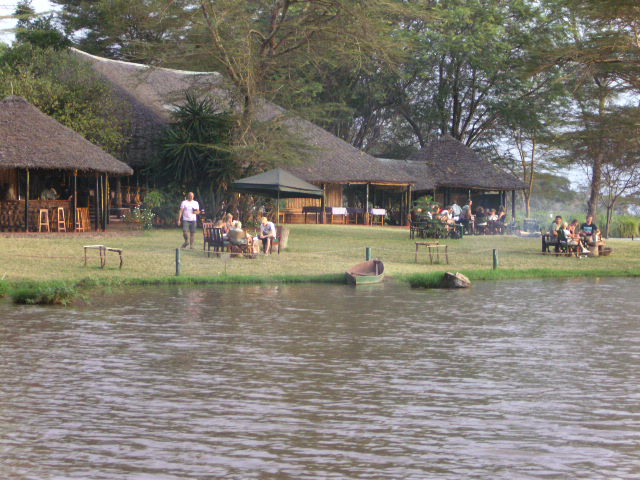
A secret lake lies in a crater within site of Kilimanjaro’s towering snow-clad mountain, only we can’t see Africa’s tallest mountain because of the thick clouds.
Formed by explosive eruptions thousands of years ago, the crater-lake is fed by underground streams from the mighty mountain.
Its turquoise blue-green waters stand in stark contrast to the dry and dusty land where fat baobabs and thorny trees tough it out under a merciless sun.
Dust trails the cars driving out from Voyager Ziwani on the edge of Tsavo West national park to the secret crater-lake, driving past red-earth anthills, the shambas of the Taveta people and the turning to the hill where Grogan built his castle in 1930.
Nobody would guess what lies in the mound amidst this non-descript terrain until one reaches the rim and a burst of blue sparkles in the volcano’s crater. So secret is it that one could easily drive past it.
Even today few people visit it but historical records show that during the First World War, the allied forces marched around the northern edge in their advance on Taveta to battle it out with the Kaiser’s force.
Scrambling down the narrow path to reach the shores of the pretty pond that’s 4.5 square kilometres and 94 metres deep with the invisible line separating Kenya and Tanzania, we meet two women climbing up with fish bought from the local fishermen.
The women, are from the shores of Lake Victoria almost 800-kilometres away. On my first visit to the lake eight years ago, nobody dared swim in it for a teenage British girl, Amy Nicholls had been killed by a crocodile.
Her body was found on the Tanzanian side and brought to Nairobi for a post-mortem where it was revealed that the culprit was a croc. A local diving team spotted one a few years ago and a pair of tusks lying on the lake bed.
On closer look, the tusks were plastic used in a film shot on location. Little boys swim by a collapsed bridge which some enterprising person wanted to build to connect Kenya and Tanzania – secretly l think it would have spoiled the beauty of the stunning lake besides affecting the natural biodiversity.
Sitting on the shore of the lake, I weigh the odds of bumping into a croc. More unlikely than being hit by a car in Nairobi and none of the local guys have seen one in many, many years.
Floating on the water surrounded by the steep walls of the volcano and its forest of euphorbia and fig trees and a blue sky above, life’s a dream. A lone African fish eagle soars above to complete the idyllic picture.
Diving a few feet underwater shows the sun’s rays filter through clear water. But like everybody in the group questions, where did the crocodile come from when there is no surface river flowing into it.
Picture by ©Gurinder Sehmi

A little investigation solves the mystery. The Challa croc-culprit is no other than Grogan, one of Kenya’s most vivid colonial characters who besides building his enormous castle on the nearby hill, pioneered large-scale farming and irrigation in Taveta.
He in his wisdom, then brought some rare dwarf crocodiles as pets and had them shipped from Madagascar in the 1930s and put into Lake Challa, which lay in his 9,650-square-mile estate.
The crocs were thought to have become extinct in the lake some years ago, many killed by the local fishermen in the 1990s when the toothy reptile continually ruined their fishing nets. Maybe it was just the lone one lurking in 2002.
Article by Rupi Mangat, rupi.mangat@yahoo.com Reproduced Courtesy of Nation Newspapers. All rights Nation Media Group Ltd. As appeared on Saturday Magazine, 20th November 2010

26 January, 2011

A superb tented lodge with true sounds of nature


In the silent night, nothing shows. Yet this blanket of darkness covers a nocturnal life that shies away in the heat of the day. A barrel shaped hippo on its tiny legs makes for the bushes.

A few metres away, a pair of silver-backed jackals hunt for the night feast of insects while elephants on the bank across the river siphon water up their trunks and into their mouth.It looks comical. We spot more. A herd of buffaloes, easily a hundred gallop away caught in the beam of the powerful torch. Their eyes sparkle like fireflies, their curved horns a pattern in the darkness.
“An elephant can take in 30 litres of water in a single ‘trunk’ full,” reveals Lekatoo Ole Parmitoro, the guide from Voyager Ziwani. Doe-eyed gazelles and graceful impalas dot the plains and as the spotlight passes over them, they vanish into the darkness yet they are there.

It’s nearly midnight when we return to Voyager Ziwani, which was a garrison for the German Schutztruppe during World War 1.
Nearly a century later, the military base is a relaxed tented camp under the Heritage flagship where the former ranch has been turned into a wildlife sanctuary expanding the range for wild animals from Tsavo West national park.
At the crack of dawn the birders are out to catch the first bird to leave the nest. Everything looks fresh – the grass with the dew, the lake so calm with water flowing through and the crocs lying so peaceful.
The ranger, Mwalimo Mwashighadi accompanies me with his ‘simi’ for a walk around the lake for you aren’t allowed to walk without a ranger. It’s an advice to heed.
Open jaws
The hippos with their tiny pink ears showing are back in the lake after a night of chomping between the tents and beyond. Nostrils give away the crocodiles in the water.
Two are sunning themselves by the banks with mouths agape waiting for the birds to clean their jaws. Gleaming white bones of a young elephant, which died in the previous year’s drought, lie on the dry earth.
A Water Thicknee raises a fracas as we near her nest on the ground. It’s a single spotted egg – the size of a chicken egg – lying in the midst of elephant dung.

We move away and watch for it to return. “It will not come straight for the egg because that will reveal it. Instead the bird will stay around it to distract what it thinks is a potential predator,” says Mwalimo.
He points to the crocodile’s nest in the ground, now abandoned. There are almost 50 of these dinosaurian reptiles in the dammed lake. But it’s the bird life that is so profuse; pied kingfishers jack dive in sight of the crocodiles.
Dainty jacanas wade lightly on the floating leaves. Hundreds of wild geese and ducks life off in the warming air to perch on the tall acacias while the sophisticated Crowned cranes fly in.
A new friend who is enjoying the morning walk poses for a photograph with the open-jawed crocodile in the background (he’s a safe distance away). I get him in the frame with the crocodile looking like its got him in its open jaw when suddenly there’s a flurry of activity and in a second, the crocodile has disappeared and the camera’s flown out of my hand.
But l got the shot and no matter how dead a crocodile looks never ever approach it on foot because it can move like lightening. Our crocodile dashed for the lake on hearing the click of the camera.
More than an hour passes as we enjoy being in the wilderness and return for breakfast. The show continues with the hippos snorting and then the African fish eagle, resplendent in coats of molten lava and white fronts sweep over the lake with talons outstretched to catch their breakfast.
It’s the most entertaining breakfast with the duo so graceful that breakfast lingers longer than it should. But then the elephants wander by and we abandon breakfast to climb the wharf where in the reeds a mother hippo guards her newborn babe – it’s cute like most babies.
The elephants keep on grazing. The breeze ruffles the branches and the grasses but the clouds keep the curtain on Kili with Mawenzi completely invisible.
Article by Rupi Mangat, rupi.mangat@yahoo.com Reproduced Courtesy of Nation Newspapers. All rights Nation Media Group Ltd. As appeared on Saturday Magazine, 20th November 2010

06 December, 2010

Leopards fighting for a kill up a tree


This footage of two Leopards fighting for a kill on a tree was taken by Dixon Chelule (DC) of Mara Intrepids while on a gane drive in the Masai Mara Reserve in July.

DC is the Assistant Head Guide, Mara Intrepids Camp.

Amazing Pics - Cheetah Goes On Game Drive, Masai Mara!


Every once in a while, the wild springs unexpected experiences. On a recent game drive, a cheetah decided it wanted a ride on one of Mara Intrepids open sided jeeps. To say that the driver was overwhelmed by the request would be an understatement.


Mara Intrepids Guides


For limited time, enjoy stays at the Masai Mara at Mara Explorer, Mara Intrepids or Siana Springs. Enquire at sales@heritagehotels.co.ke now.