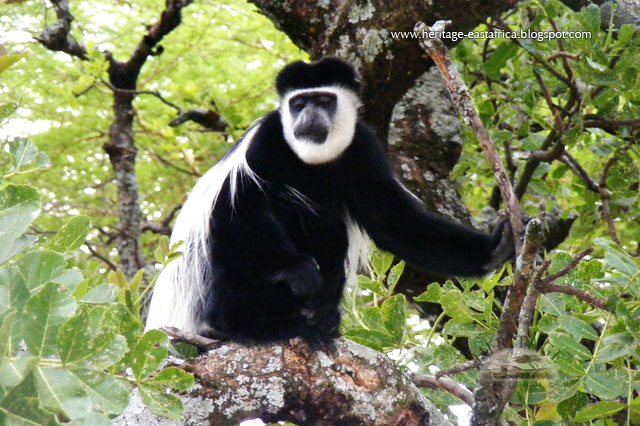
For the first time, a male colobus monkey (Colobus abyssinicus) was seen at the
Great Rift Valley Lodge. This is seen as a good sign, for these shy creatures
are rare and very selective feeders. Being arboreal, they spend their time in
tree tops and feed on leaves.
A lone male was seen at the lodge, feeding on the ipomoea
flowers which are now common around the tennis courts and the surrounding
bushes.
We hope that he will be joined by the rest of the troop.
They are common around Lake Naivasha and the Crater Lake which are seven and
eighteen kilometers away respectively.
Fact File
The name “colobus” is derived from the Greek word for
“mutilated,” because unlike other monkeys, colobus monkeys do not have thumbs.
Their beautiful black fur strongly contrasts with the long white mantle,
whiskers and beard around the face and the bushy white tail. The Eastern
black-and-white is distinguished by a U-shaped cape of white hair running from
the shoulders to lower back, whereas the Angolan black-and-white has white
hairs flaring out only at the shoulders.
Habitat
There are three types of colobus monkeys found in Kenya. The
Angolan colobus monkey is found at the coastal forests, the Guereza colobus in
inland high-country areas. The Red colobus monkeys, the rarest are found in the
forests of the Tana Delta.
Behavior
The colobus is arboreal and only rarely descends to the
ground. It uses branches as trampolines to leap up to 50 feet across. Their
mantle hair and tails are believed to act as a parachute during these long
leaps.
Colobus monkeys live in troops of about five to 10 animals—a
dominant male, several females and young. Each troop has its own territory
which is well defined and defended from other troops. Adult troop members,
especially males, make croaking roars that can be heard resonating throughout
the forest.
Fighting over mates rarely occurs. There is no distinct
breeding season although most mating probably occurs during rainy season.
Because a female suckles her infant for over a year, an average of 20 months
passes before she gives birth again. Other troop members often handle very
young infants. In the first month when the infant still has a pink face, it may
be handled three to five times an hour in resting groups. Infant mortality is
high even though the young are carefully tended.
The newborn colobus monkey is covered with white fur, and at
about 1 month gradually begins to change color, finally gaining the black and
white adult coloration at about 3 months. The infant monkey is carried on the
mother's abdomen, where it clings to her fur. As it matures it spends a lot of
time playing with its mother and certain other adults and at about 7 months
begins playing with other juveniles. The games they play exercise their bodies,
and as they get older, these develop into wrestling matches and mock displays.
Diet
Colobus monkeys are strictly leaf-eaters and spend most of
their time in treetops, preferring to eat the tender young leaves found there. Their
complex stomachs enable them to digest mature or toxic foliage that other
monkeys cannot.
Predators and Threats
At one time the colobus was hunted excessively for its
beautiful fur, leading to its extermination in some areas. Its skin has been
used to make costumes, hats and capes. Today, the greatest threat to it is the
loss of habitat as forests are cut down.
Did You Know?
- The
name colobus derives from a word meaning "mutilated one" because
unlike other monkeys they do not have thumbs.
- The
monkeys communicate with a song-like call, a warning call and a mating
call. Local tradition says they are good weather forecasters because they
become silent when bad weather is coming.
Resident Impala and Warthogs
-->
The new bush dinner area is called Volans after the flying
fish. It is named after a constellation. It can be seen from the Lodge during the
star gazing sessions but its visibility depends on the time of the year.
In addition, there are now twelve resident impalas and three
warthogs living on the grounds of the Lodge, happy with all the grass they have
around them to feed on.
A nature walk at the lodge has become one of the most
interesting activities.
Report by Daniel Kilonzo, Resident Naturalist at Great Rift Valley Lodge and Golf Resort. Pictures, File.
Heritage Hotels (Kenya) manages The Great Rift Valley Lodge and Golf resort in Naivasha, just an hour an a half's drive from Nairobi. The lodge is famous for one the longest holes in Kenya - the par 5 - 17th ‘signature’ at 598 metres (654 yards)!
©Heritage Hotels Ltd, Kenya.